Cybersecurity for Financial Services Companies in DIFC: A Practical Guide for CIOs, CTOs and CISOs
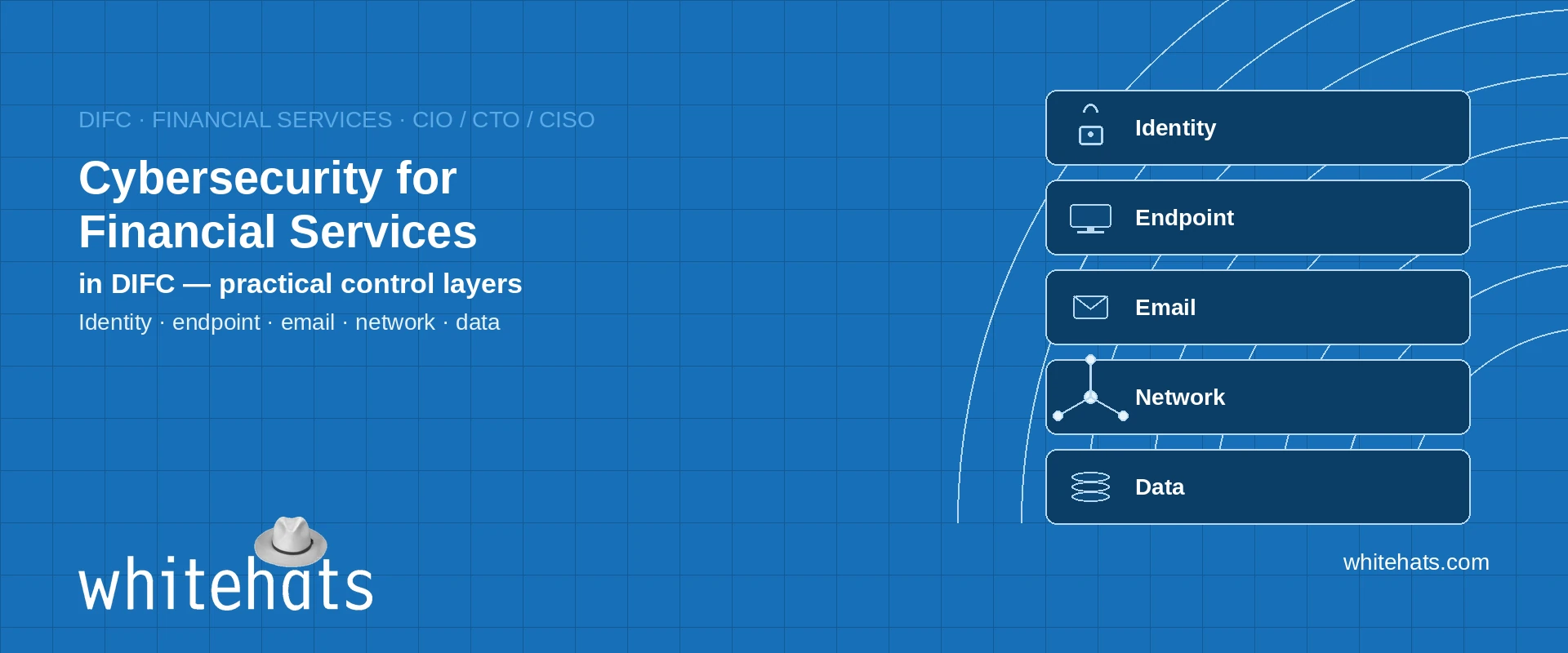
A practical guide for CIOs, CTOs and CISOs responsible for cybersecurity in financial services companies operating in DIFC.
Financial services organisations operate in an environment where technology, information security and business continuity are closely connected. For companies in the Dubai International Financial Centre (DIFC), cybersecurity is not simply an IT department responsibility. It is a business risk that can affect client confidentiality, operational resilience, regulatory obligations and organisational reputation.
Financial institutions, investment firms, wealth managers, professional services companies and other businesses handling sensitive information must consider how their technology environments are protected against increasingly sophisticated cyber threats.
This guide explores the cybersecurity areas financial services companies in DIFC should assess, the technologies that can strengthen their security posture, and how international organisations can coordinate global cybersecurity standards with local IT operations in Dubai.
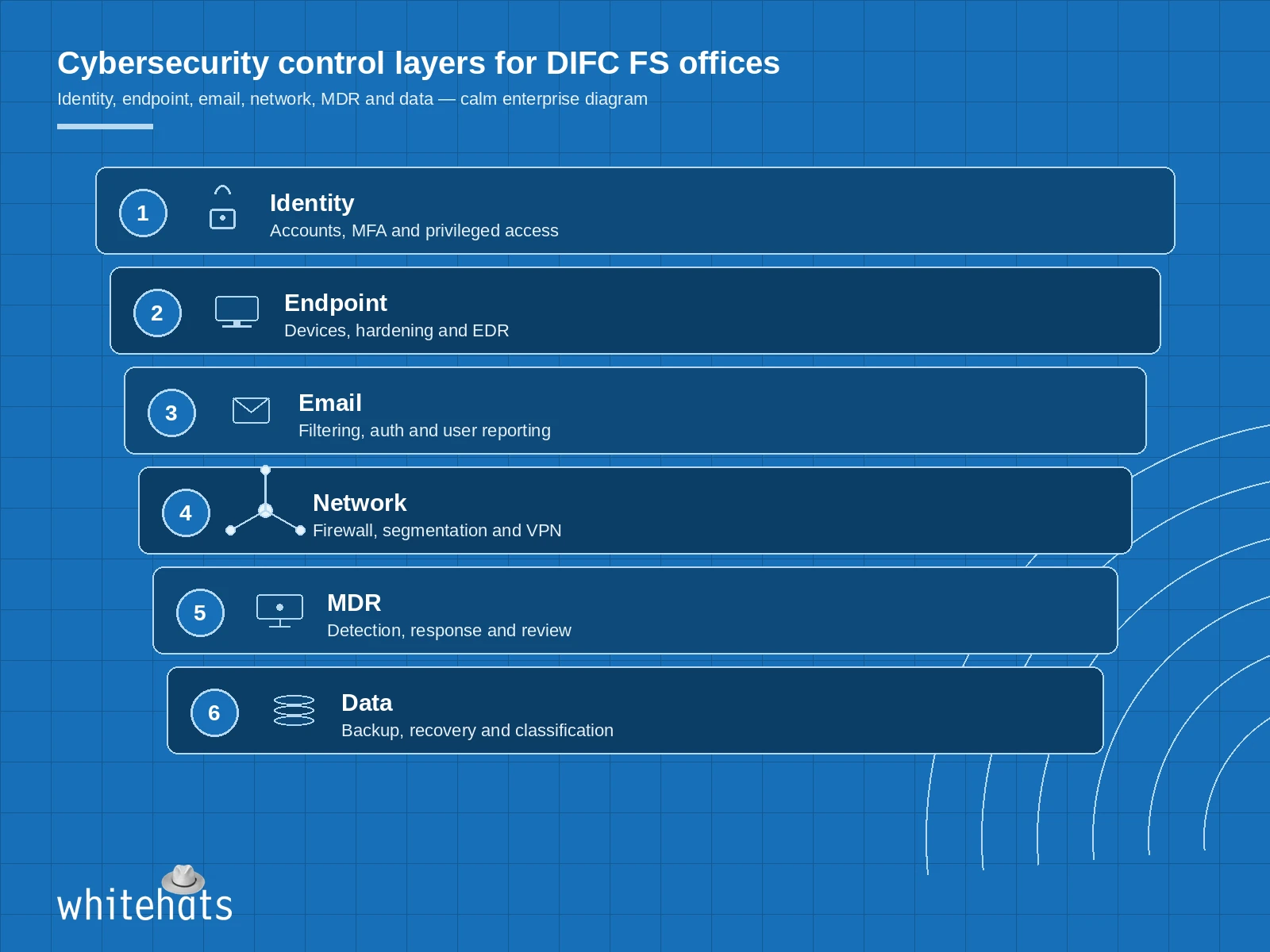
Cybersecurity controls financial services offices in DIFC should assess together.
On this page
- Why cybersecurity matters for financial services companies in DIFC
- Understanding the cybersecurity responsibilities of DIFC businesses
- Essential cybersecurity controls every financial services business should assess
- Why Zero Trust should be part of the security strategy
- Protecting Microsoft 365 environments in financial services
- Cybersecurity challenges for international companies operating in Dubai
- A practical cybersecurity assessment checklist for DIFC businesses
- How Whitehats supports cybersecurity and IT security projects in Dubai
- Frequently asked questions
1. Why cybersecurity matters for financial services companies in DIFC
Financial services organisations manage valuable information, including client records, financial data, business communications, investment information and confidential documents. That makes them attractive targets for cybercriminals.
Common threats include:
- Phishing and business email compromise
- Ransomware and malware
- Stolen credentials and account takeover
- Unauthorised access to sensitive information
- Insider threats and misuse of privileged accounts
- Vulnerabilities in endpoints and business applications
- Compromised third-party suppliers
- Data leakage through email, cloud storage or unmanaged devices
- Disruption of critical business services
A successful attack can result in financial losses, operational disruption, exposure of confidential information, legal consequences and reputational damage. Consequences may extend beyond the affected organisation when a company is part of a wider international group.
2. Understanding the cybersecurity responsibilities of DIFC businesses
DIFC has its own legal and regulatory framework, including the DIFC Data Protection Law, which is relevant to organisations processing personal data within its scope. Financial services firms may also have additional obligations depending on their activities, regulatory status and applicable DFSA requirements.
It is important to distinguish between:
- Data protection — how personal data is collected, processed, stored, accessed and protected
- Cybersecurity — how systems, networks, applications and information are protected against threats
- Operational resilience — how the organisation maintains or restores critical business services during disruption
- Regulatory compliance — how the organisation meets the specific legal and regulatory requirements applicable to its activities
These areas overlap, but they are not interchangeable. A firewall or endpoint security product alone does not make an organisation compliant. Technology should support a broader governance, risk management and security programme. Companies should confirm specific obligations with their legal, compliance and risk teams.
3. Essential cybersecurity controls every financial services business should assess
A. Identity and access management
Identity is one of the most important security boundaries in a modern business. Employees, contractors, administrators and third-party suppliers may access company systems from different locations and devices. Weak authentication or excessive permissions expose the organisation to significant risk.
A strong identity security strategy should consider multi-factor authentication, role-based access control, least-privilege access, privileged identity management, conditional access policies, secure remote access, regular access reviews, and prompt removal of access for departing employees.
Microsoft Entra ID manages identity, authentication and access policies across supported Microsoft environments. For international organisations, align identity policies with global standards while ensuring local users and administrators receive only the access required for their responsibilities.
B. Endpoint security and device management
Laptops, desktops and mobile devices are common entry points for cyberattacks. Financial services employees may access confidential information from office locations, home networks, client sites and while travelling.
Endpoint security should include endpoint detection and response, anti-malware protection, device encryption, operating system and application patching, security configuration baselines, USB and peripheral controls where required, device compliance monitoring, and centralised device management.
Microsoft Intune manages supported Windows, macOS and mobile devices, while endpoint protection platforms provide additional security capabilities. A device should not automatically be trusted simply because it belongs to an employee.
C. Email security and phishing protection
Email remains a major attack channel. Financial services organisations are particularly exposed to impersonation attempts, fraudulent payment instructions, credential theft and business email compromise.
Important controls include anti-phishing protection, malicious attachment and URL scanning, sender authentication using SPF, DKIM and DMARC, multi-factor authentication, protection against account takeover, email threat monitoring, and employee security awareness training.
Organisations should also implement clear verification procedures for sensitive financial instructions and changes to supplier bank details. Technology reduces risk, but business processes and employee awareness remain essential.
D. Firewall and network security
The corporate network connects employees, devices, servers, cloud applications and business systems. A properly designed network security architecture should include next-generation firewall protection, intrusion prevention, network segmentation, secure VPN or zero-trust remote access, guest network isolation, secure wireless access, centralised logging and network traffic monitoring.
Segmentation is particularly important. Guest Wi-Fi should not provide access to internal business systems, and sensitive infrastructure should be separated from general employee networks. The objective is to reduce unnecessary access and limit the potential spread of an attack.
E. Managed detection and response (MDR)
Prevention is essential, but no security solution can guarantee that every threat will be blocked. Organisations also need visibility into suspicious activity and a process for investigating and responding to potential incidents.
Managed detection and response can provide security event monitoring, threat detection and investigation, endpoint threat analysis, suspicious activity identification, incident escalation, response recommendations, and support with containment activities depending on service scope.
MDR can be particularly useful for organisations that do not have the internal resources to operate a dedicated security operations centre. When evaluating an MDR provider, ask which systems are monitored, what hours are covered, how incidents are classified and who is authorised to take response actions.
F. Data protection and information governance
Financial services businesses need to understand where sensitive information resides and who can access it — including Microsoft 365, SharePoint and OneDrive, email systems, end-user devices, file servers and NAS storage, cloud applications and backup repositories.
Relevant controls may include data classification, access restrictions, encryption, data loss prevention, retention policies, secure sharing, audit logging, and backup and recovery. Microsoft Purview provides capabilities that can support information protection, data governance and compliance workflows, depending on licensing and configuration. Select the solution based on the organisation’s data types, risks and applicable requirements.
4. Why Zero Trust should be part of the security strategy
Traditional network security often assumes that users and devices inside the corporate network can be trusted more than those outside it. Modern businesses need a more flexible approach.
Zero Trust is based on verifying access rather than automatically trusting a user or device based on network location. A practical Zero Trust strategy considers:
- Verify explicitly — authenticate users and assess relevant access conditions
- Use least privilege — grant only the access needed for a task
- Assume breach — design controls to limit the impact of compromised accounts or devices
For a financial services organisation, this may involve strong identity verification, device health and compliance checks, conditional access, privileged access controls, application-level access restrictions, network segmentation and continuous monitoring. Zero Trust is not a single product. It is an architectural approach involving identity, devices, applications, networks and data.
5. Protecting Microsoft 365 environments in financial services
Many financial services companies use Microsoft 365 for email, document collaboration, meetings and business productivity. A default deployment may not provide the security configuration required by a particular organisation.
| Security area | What should be assessed |
|---|---|
| Identity | MFA, conditional access and privileged accounts |
| Anti-phishing, spoofing protection and email authentication | |
| Devices | Intune policies, encryption and compliance |
| Information | Data classification and access permissions |
| Collaboration | External sharing and guest access |
| Monitoring | Audit logs and suspicious activity |
| Recovery | Backup and restoration arrangements |
Licensing matters. Microsoft 365 Business, Enterprise and security add-on plans provide different capabilities. Organisations should map requirements to the appropriate licensing and configuration rather than assuming every feature is included.
6. Cybersecurity challenges for international companies operating in Dubai
International businesses frequently have a global IT department or an established security operations team outside the UAE. The Dubai office still needs local implementation, support and coordination.
Common challenges include:
- Global policies vs local operations — the local environment should follow the organisation’s security standards for identity, endpoint, network and data protection
- Local onsite support — some security and infrastructure issues require physical intervention, such as firewall replacement, network isolation, hardware troubleshooting or device deployment
- Consistent device standards — Windows and Apple Mac devices should follow approved corporate policies and security baselines
- Third-party access — external IT providers, maintenance teams and contractors should receive controlled access based on documented business requirements
- Incident escalation — the Dubai office should know how to report suspicious activity, who to contact and how incidents escalate to global security teams
A clearly defined responsibility model helps prevent gaps between global security governance and local IT operations.
7. A practical cybersecurity assessment checklist for DIFC businesses
CIOs, CTOs, CISOs and IT managers can use this checklist to begin reviewing their environment. It is a starting point, not a formal compliance assessment or certification.
Identity and access
- MFA is enforced for relevant accounts
- Privileged accounts are controlled and reviewed
- Access is granted according to job responsibilities
- Departing employees have access revoked promptly
Endpoint protection
- Company devices have active endpoint protection
- Operating systems and applications are patched
- Device encryption is enforced where required
- Device compliance is monitored
Email and collaboration
- Email security policies are configured
- SPF, DKIM and DMARC are reviewed
- External sharing permissions are controlled
- Employees receive security awareness training
Network and infrastructure
- Firewall policies are reviewed
- Guest and corporate networks are separated
- Remote access is secured
- Critical infrastructure is monitored
Data and business continuity
- Sensitive information is identified and classified
- Data access permissions are reviewed
- Backups are monitored and restoration is tested
- Incident response and recovery procedures are documented
Monitoring and response
- Security logs are available and reviewed
- Incident escalation contacts are documented
- Response responsibilities are clearly defined
- Third-party access is controlled
8. How Whitehats supports cybersecurity and IT security projects in Dubai
Whitehats LLC provides IT infrastructure and cybersecurity solutions for businesses in Dubai and the UAE. For financial services organisations and international companies, Whitehats supports technology initiatives across:
- Cybersecurity assessments and security improvement projects
- Firewall and network security implementation
- Endpoint protection and managed security solutions
- Identity and access management
- Microsoft 365 security configuration
- Data protection and backup solutions
- Infrastructure security and network segmentation
- Security technology deployment and ongoing IT support
Whitehats also coordinates with internal IT teams and international headquarters to align local implementation with approved technical standards and operational procedures. Scope depends on the organisation’s environment, existing security tools, internal capabilities and applicable regulatory requirements. Related pages: Whitehats cybersecurity services and managed IT services.
9. Frequently asked questions
Speak with Whitehats
For financial services organisations in DIFC and international businesses operating in Dubai, establish security controls that align with business risks, internal policies and applicable obligations. Discuss a cybersecurity assessment, Microsoft 365 security review or infrastructure security project with Whitehats LLC.
UAE companies with 20+ staff can request a free onsite IT Support & Security Assessment.
Contact: contact Whitehats | +971 4 338 2500
Whitehats LLC — Al Quoz 3, Dubai, UAE