IT Support Companies in Dubai: The Complete Guide for International Businesses and Growing Enterprises
Choosing an IT support company in Dubai is more than finding someone to fix computers. Your IT partner influences business continuity, cybersecurity, employee productivity, data protection and the reliability of your office infrastructure.
For international companies establishing a Dubai office, or businesses replacing an existing IT provider, the right partner matters. You may have a global IT team or headquarters overseas, but the Dubai office still needs dependable local support, onsite assistance and a provider that implements your technology requirements on the ground.
This guide explains what to look for when choosing an IT support company in Dubai, which services belong in scope, how managed IT support works and the questions every business should ask before signing a contract.
Local IT support that stays aligned with international headquarters standards.
On this page
- Why businesses in Dubai need a reliable IT support partner
- What services should a professional IT support company provide?
- Managed IT services vs hiring an in-house IT team
- What international companies should consider when selecting an IT partner in Dubai
- How much does IT support cost in Dubai?
- Important questions to ask before signing an IT support agreement
- Why consider Whitehats for IT support in Dubai
- Frequently asked questions
1. Why businesses in Dubai need a reliable IT support partner
Modern businesses depend on technology for almost every operational activity. From email and cloud applications to networks, cybersecurity, meeting rooms and business-critical systems, even a small IT issue can disrupt an entire team.
Common challenges include:
- Employees unable to access email, files or business applications
- Slow networks, unreliable Wi-Fi and connectivity interruptions
- Microsoft 365 account, licensing and authentication issues
- Cybersecurity incidents, phishing and suspicious activity
- Server, storage and backup failures
- Meeting-room and video-conferencing problems
- New-employee onboarding and employee offboarding
- Lack of visibility over IT assets, warranties and licences
- Delayed support from an existing IT provider
For companies with international headquarters, there is an additional challenge: maintaining alignment with global IT policies while ensuring the local Dubai office receives timely technical support. A capable IT support partner bridges that gap.
2. What services should a professional IT support company provide?
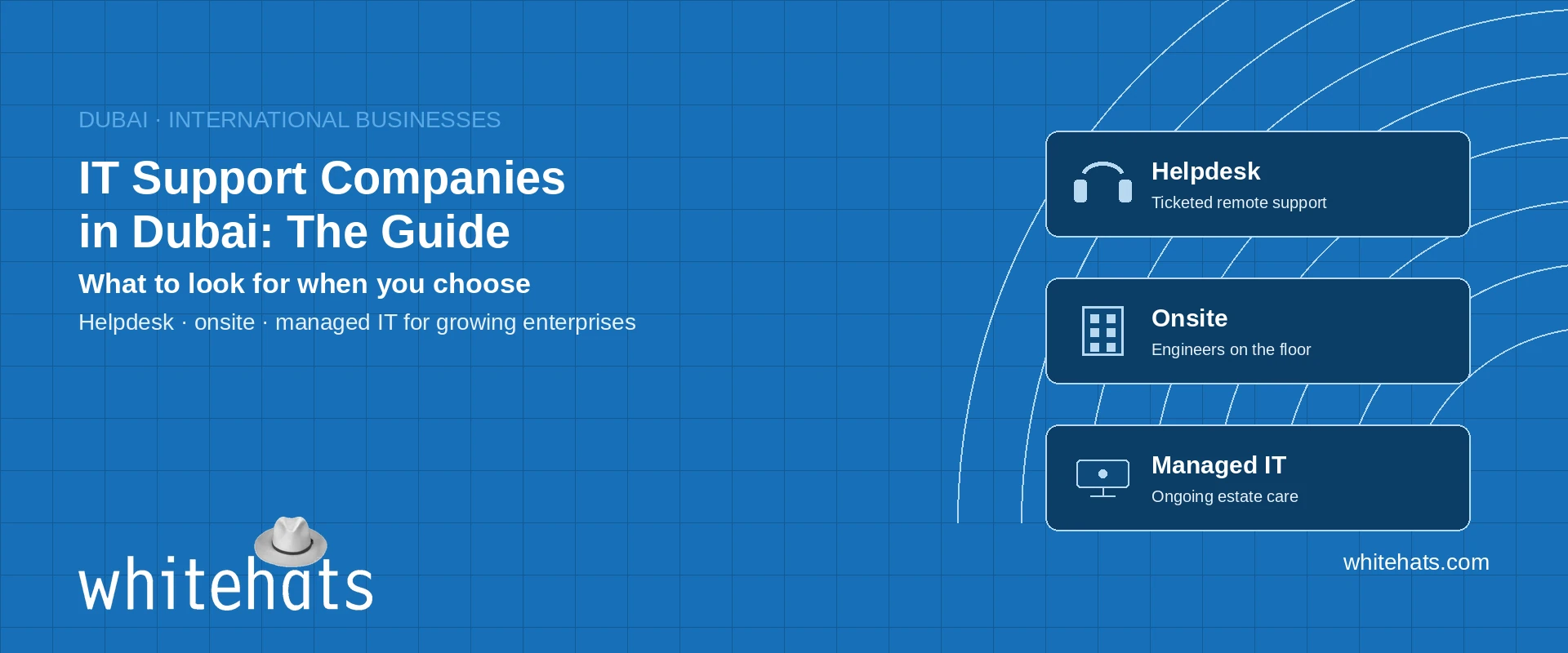
Not all IT support companies offer the same level of service. Some focus mainly on desktop troubleshooting; others provide a broader managed IT service covering infrastructure, cloud, cybersecurity and business continuity. Before choosing a provider, understand which services your organisation actually needs.
A. Helpdesk and end-user support
Employees need a reliable channel to report IT problems and receive assistance. Typical services include:
- Desktop and laptop troubleshooting
- Windows and macOS support
- Email and Microsoft 365 support
- Printer and peripheral troubleshooting
- User account and password assistance
- Software installation and configuration
- Remote and onsite technical assistance
- Employee onboarding and offboarding
For businesses with multiple departments or locations, a structured ticketing system ensures requests are recorded, prioritised and tracked.
B. Network and infrastructure support
Your network is the foundation of the office technology environment. A professional IT provider should support:
- Business-grade firewalls and network security
- Managed switches and wireless access points
- Corporate Wi-Fi design and optimisation
- Structured cabling and network points
- VLANs and network segmentation
- VPN and secure remote connectivity
- Servers, NAS and storage systems
- Network monitoring and troubleshooting
For a new office, involve your IT provider at the planning stage rather than only after the office is operational. Related: structured cabling context.
C. Microsoft 365 and cloud services
Many businesses use Microsoft 365 for email, collaboration, file sharing and productivity. Your IT support provider should understand Exchange Online and Microsoft 365 administration, Microsoft Entra ID and identity management, multi-factor authentication, Microsoft Intune and device management, SharePoint and OneDrive, Microsoft Teams, Microsoft 365 security configuration, and licensing and tenant administration.
For international companies, establish clear ownership and administrative responsibilities between the global IT department and the local support provider.
D. Cybersecurity and endpoint protection
Traditional IT support is no longer enough if cybersecurity is treated as a separate concern. Businesses should consider endpoint detection and response, managed detection and response, email security and phishing protection, firewall management, identity and access protection, vulnerability assessment, security monitoring and incident escalation, and backup and recovery planning.
The objective is not simply to install security software. Establish a coordinated approach that reduces risk and helps the business respond when something goes wrong. See Whitehats cybersecurity services.
E. Backup and disaster recovery
A business should know how critical data will be recovered after accidental deletion, hardware failure, ransomware or another disruptive incident. Ask your IT provider what data is backed up, how frequently backups run, where copies are stored, whether backups are protected from unauthorised modification, how restoration is tested, and expected recovery time and recovery point objectives. A backup solution should be tested, not simply assumed to be working.
F. Meeting rooms and collaboration technology
Modern offices rely on video conferencing and hybrid collaboration. Your provider may also need to support Microsoft Teams Rooms, Logitech meeting-room systems, video-conferencing equipment, wireless presentation systems, room scheduling panels, digital signage, and boardroom audio and video. Design and support these systems as part of the wider office IT environment.
3. Managed IT services vs hiring an in-house IT team
One of the most common decisions businesses face is whether to employ internal IT personnel or outsource IT support to a managed service provider. Both models can work. The right choice depends on business size, complexity, security requirements and support expectations.
| Consideration | In-house IT team | Managed IT provider |
|---|---|---|
| Staffing | Employees on payroll | External service agreement |
| Technical expertise | Depends on team size | Access to a broader team |
| Coverage | Limited by available staff | Defined contractual coverage |
| Scalability | Recruitment may be required | Can scale with requirements |
| Onsite support | Internal availability | Based on agreed SLA |
| Cost structure | Salary and employment costs | Contracted service fees |
| Accountability | Internal management | Contractual service commitments |
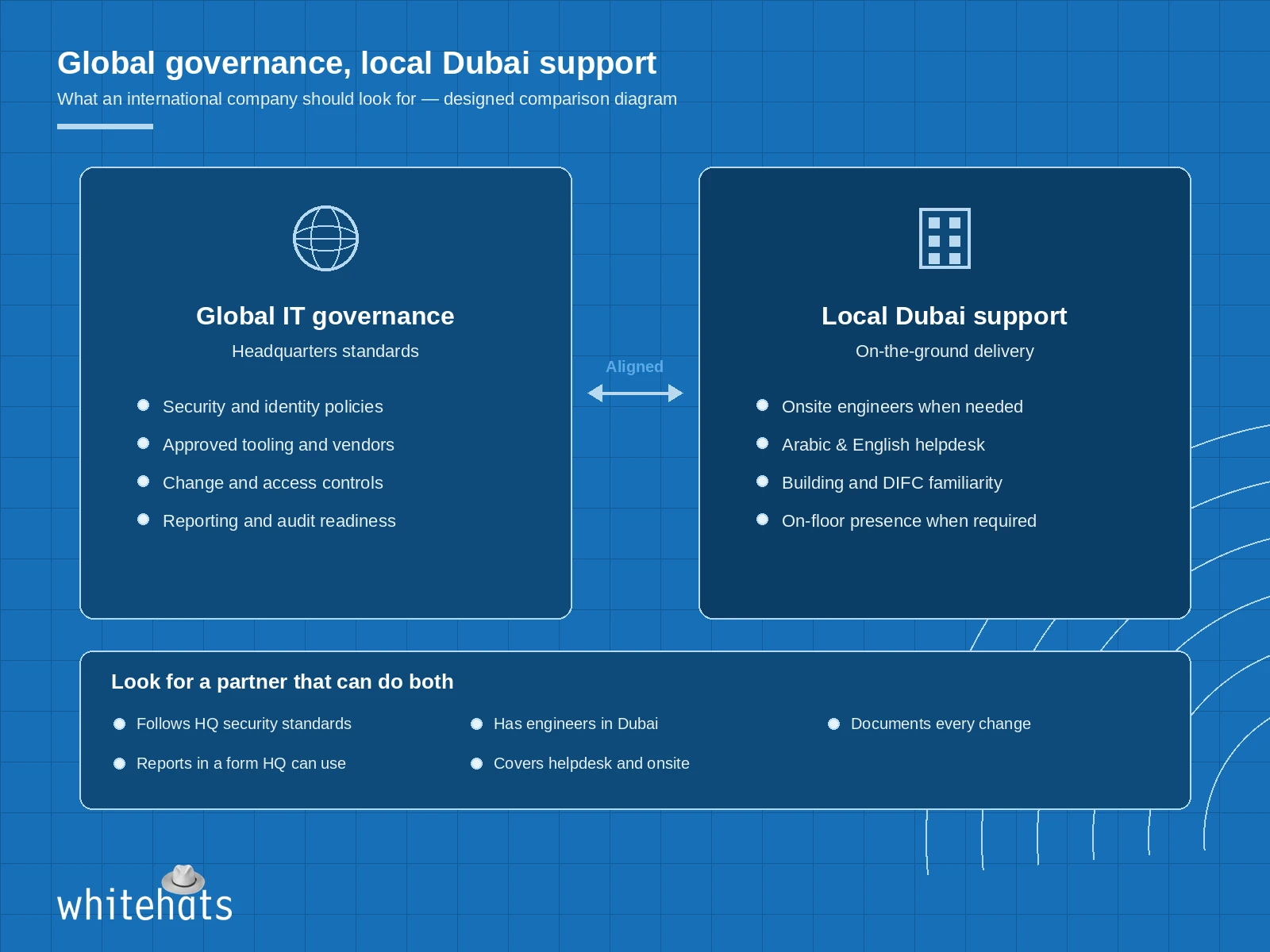
Some organisations prefer a hybrid model: an internal IT manager or global IT department supported by a local managed IT provider. This is especially effective for international businesses operating in Dubai. The internal team retains control of IT strategy, architecture and governance, while the local partner handles agreed operational support, onsite requirements and implementation projects. See the managed IT overview.
4. What international companies should consider when selecting an IT partner in Dubai
An IT company that supports small local businesses may not automatically suit an international organisation. If your headquarters is in the UK, USA, Europe or another region, consider the following.
Alignment with global IT policies
Your Dubai IT partner should work within the standards and procedures defined by your global IT department. That may include global identity and access management policies, standardised device configurations, endpoint security requirements, centralised Microsoft 365 administration, security incident escalation procedures, and change management and documentation.
Local onsite capability
Remote support is useful, but not every issue can be resolved remotely. You may require a technician for hardware replacement, network troubleshooting, new-employee setups, office relocations or meeting-room installations. Confirm where the provider operates and what onsite response commitments can be contractually agreed.
Documentation and transparency
Your IT provider should maintain clear records of network diagrams, IT asset inventory, administrator access and responsibilities, configuration information, support tickets, backup arrangements, licences and renewals, and project documentation. Documentation reduces dependency on individual technicians and makes future changes easier.
Security and confidentiality
Ask how the provider manages privileged access, remote support tools, customer information and security incidents. Understand what access is granted, who can use it, how it is monitored and how access is revoked when a contract ends.
5. How much does IT support cost in Dubai?
There is no single price that applies to every business. IT support costs depend on the number of users, devices, locations, infrastructure complexity, required service hours and the scope of responsibilities.
| Cost factor | Why it matters |
|---|---|
| Number of users | Determines helpdesk workload |
| Number of devices | Affects monitoring and maintenance |
| Server and cloud environment | Adds administration responsibilities |
| Cybersecurity scope | May require additional security tools and monitoring |
| Onsite support | Depends on frequency and response commitments |
| Service hours | Business-hours and extended coverage differ |
| Project work | New deployments and major changes may be separate |
When comparing quotations, do not compare only the monthly fee. Check whether the quotation includes licensing, cybersecurity tools, backup management, onsite visits, project work, extended-hours support and hardware replacement. A lower monthly price may simply exclude services your business will eventually need.
6. Important questions to ask before signing an IT support agreement
- Do you provide both remote and onsite support?
- What response and resolution targets are included in the SLA?
- How are critical incidents escalated?
- Do you support both Windows and Apple Mac environments?
- Can you manage Microsoft 365 and Entra ID?
- Do you provide firewall and endpoint security management?
- Do you monitor infrastructure proactively?
- How do you document configurations and IT assets?
- Can you coordinate directly with our global IT team?
- What happens to our data, accounts and documentation if we change providers?
Request a written scope of work and a clear service-level agreement. Verbal assurances are not a substitute for contractual commitments.
7. Why consider Whitehats for IT support in Dubai
Whitehats LLC provides IT services and technology solutions to businesses in Dubai and across the UAE. For organisations that need a local technology partner, Whitehats supports:
- Managed IT support and onsite technical assistance
- IT infrastructure design and implementation
- Network, firewall and wireless solutions
- Microsoft 365 and cloud services
- Cybersecurity and managed security solutions
- Data protection and backup solutions
- Server and storage infrastructure
- Meeting-room and collaboration systems
- Office IT setup, relocation and technology upgrades
For international businesses, the objective is local implementation and operational support while coordinating with the organisation’s existing IT leadership and policies. Start with a review of your current IT environment, support requirements and business priorities. Service page: Whitehats IT support company in Dubai.
8. Frequently asked questions
Speak with Whitehats
Whether you are establishing a new office, replacing your current IT provider or adding onsite support capacity, Whitehats assesses your requirements and recommends an appropriate IT support solution for your Dubai operation. Discuss IT support requirements with Whitehats LLC.
UAE companies with 20+ staff can request a free onsite IT Support & Security Assessment.
Contact: contact Whitehats | +971 4 338 2500
Whitehats LLC — Al Quoz 3, Dubai, UAE