Setting Up or Relocating Your IT Infrastructure in DIFC, Dubai: The Complete Guide for International Companies
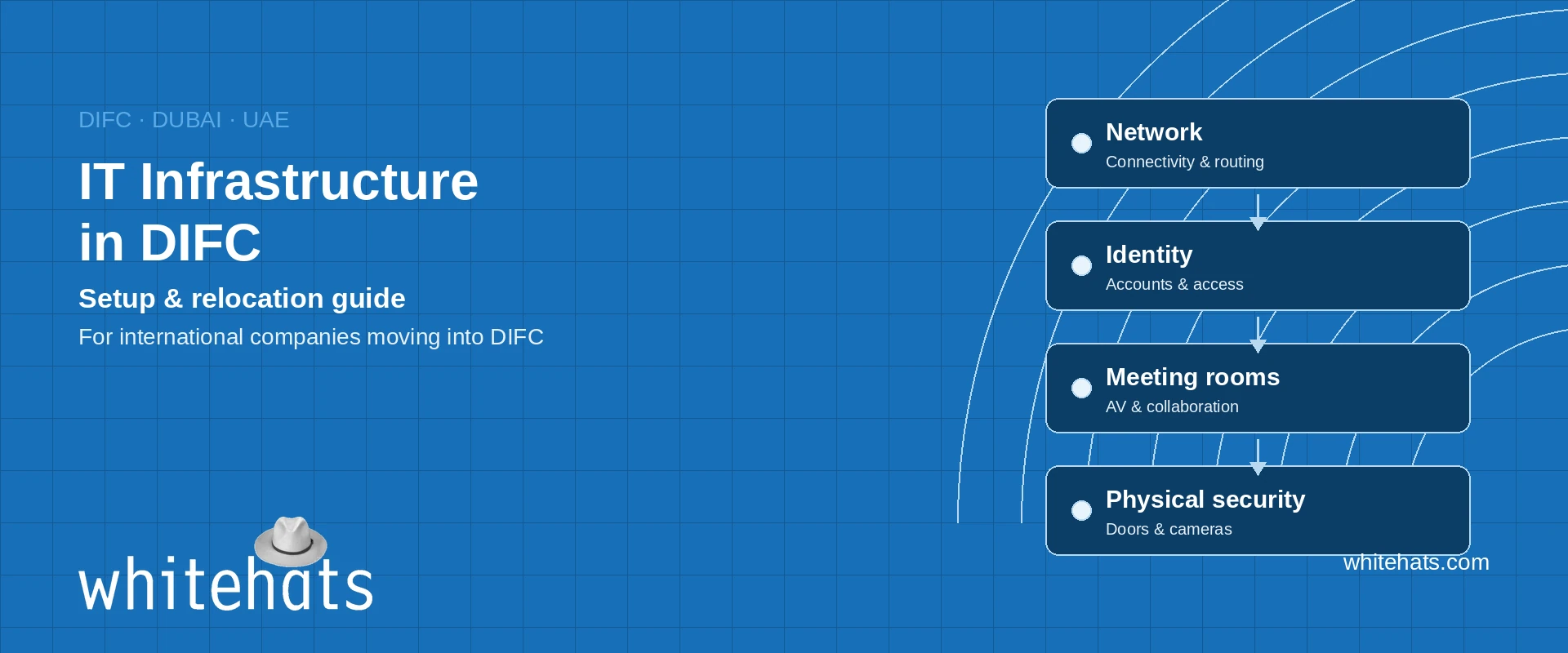
A practical guide for global IT directors, CIOs, CTOs and business leaders establishing, expanding or relocating Dubai offices in DIFC.
Dubai remains a primary destination for international financial institutions, investment firms, fintech companies, consulting businesses, technology providers and multinational organisations. For many of these companies, a presence in the Dubai International Financial Centre (DIFC) sits inside a wider international expansion plan.
Opening an office in DIFC involves more than office space, hiring and a business licence. A separate critical project often receives too little attention until the fit-out is nearly complete: planning, implementing and securing the office IT infrastructure.
Enterprise networking, structured cabling, Wi-Fi, firewalls, Microsoft 365, identity management, cybersecurity, video surveillance, cloud access control and ongoing IT support must work as one environment. The challenge grows when the global IT department sits in London, New York, Frankfurt, Zurich, Paris or another headquarters.
Who coordinates local implementation? Who keeps the Dubai office aligned with global standards? Who manages the network, security systems, user devices and connectivity? Who is accountable when the office must open for business?
That is the role of an experienced local IT infrastructure partner. Whitehats establishes, relocates, upgrades and manages IT environments for organisations in Dubai. This guide sets out what international companies should plan before establishing or relocating IT infrastructure in DIFC.
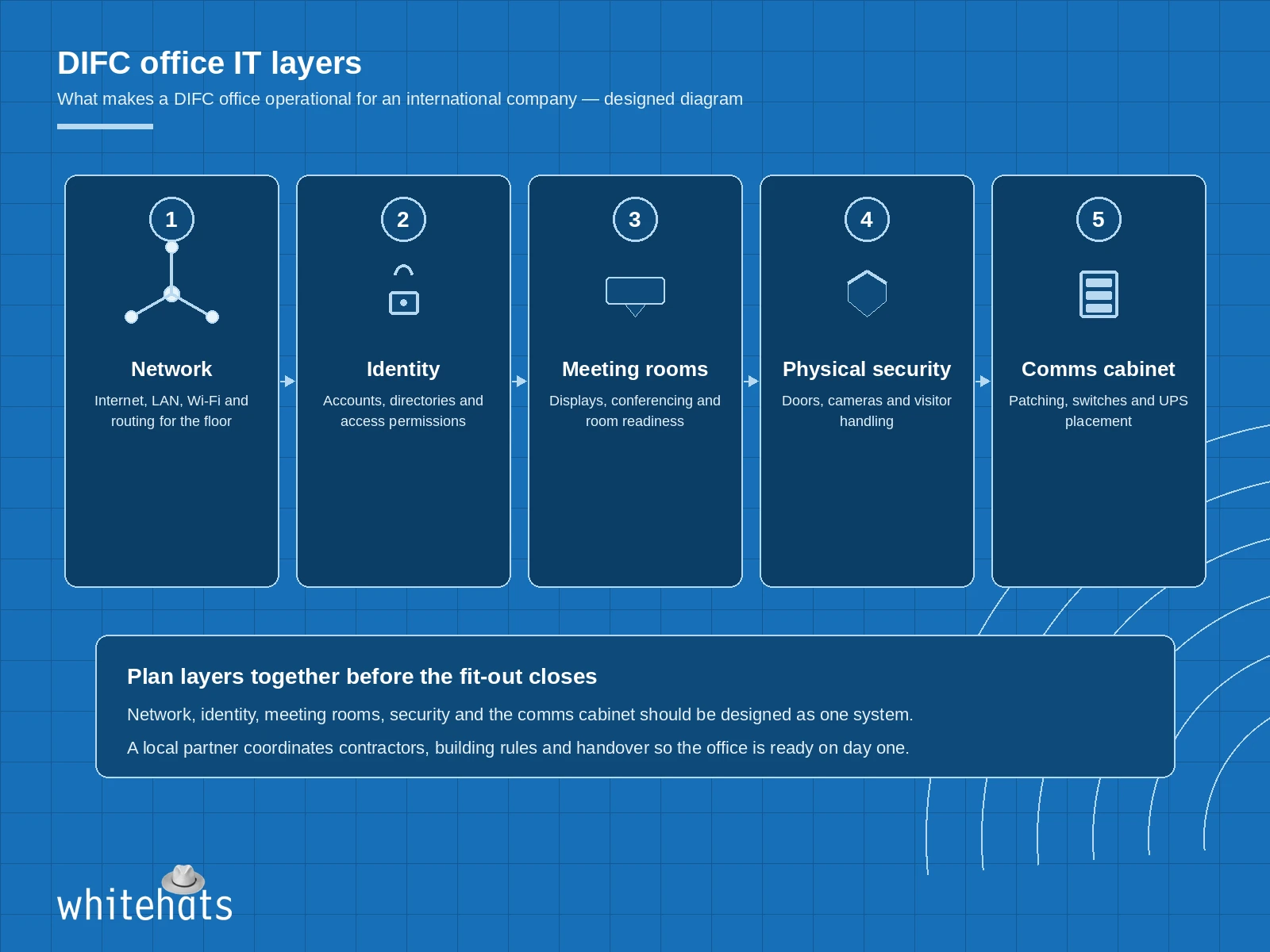
IT layers that make a DIFC office operational for an international company.
On this page
- Why IT infrastructure planning should start before your DIFC office opens
- How international headquarters can manage IT implementation in Dubai
- Complete IT infrastructure setup for a DIFC office
- Office relocation in DIFC: moving IT without disrupting operations
- DIFC office security: cybersecurity, access control and video surveillance
- Is your DIFC office IT setup aligned with global cybersecurity standards?
- What should an international company include in its DIFC IT project budget?
- Choosing the right IT infrastructure partner in DIFC
- Why international companies work with Whitehats on DIFC IT projects
- Frequently asked questions
1. Why IT infrastructure planning should start before your DIFC office opens
One of the most common mistakes when establishing or relocating an office is treating IT as the final stage of the fit-out. IT planning should begin alongside office design and workspace planning.
A modern financial services or professional services office typically needs:
- Enterprise-grade wired and wireless networking
- Business-class firewalls and secure internet connectivity
- Structured network cabling and server-room or cabinet infrastructure
- Microsoft 365, Entra ID and endpoint management
- Secure remote access and site-to-site VPN connectivity
- Workstations, laptops, docking stations and meeting-room technology
- IP telephony and unified communications
- Network monitoring and cybersecurity
- Cloud-based access control and visitor management
- CCTV and video surveillance
- Backup, disaster recovery and business continuity
- Local IT support and ongoing infrastructure management
If these requirements are not identified early, businesses face expensive changes, delayed openings, connectivity problems and security gaps. For an international company, weak local infrastructure also creates complications for the global IT department when the Dubai estate must integrate with corporate systems.
Plan the Dubai IT environment as an extension of the company’s global technology infrastructure — not as an isolated office installation.
2. How international headquarters can manage IT implementation in Dubai
Many organisations expanding into DIFC already have established IT departments and infrastructure standards at headquarters. Their teams may operate from the UK, Europe, the United States or other regions. They generally do not want a separate technology stack for a relatively small regional office. They want the Dubai operation to follow corporate policies, security standards and support processes.
Implementing those requirements locally still needs coordination. A local IT partner should work with the international IT department on:
Global network standards
Design the Dubai office around the organisation’s network architecture, IP addressing, VLAN requirements, firewall policies and connectivity strategy.
Identity and access management
Align user authentication, permissions, device registration and access policies with the company’s identity platform and security requirements.
Endpoint and device management
Provision laptops, desktops and mobile devices to corporate standards, with encryption, security policies and endpoint protection.
Cybersecurity integration
Support centralised monitoring, vulnerability management, endpoint detection, secure remote access and incident escalation.
Documentation and handover
Deliver network diagrams, firewall configurations, device inventories, credentials procedures and operational documentation to the global IT team.
Ongoing local support
When employees face connectivity, hardware, software or meeting-room issues, a local team should respond without depending entirely on overseas support.
Whitehats acts as the local implementation and support partner, coordinating with headquarters IT throughout the project. The global IT team retains governance and control, with local technical resources available in Dubai. See Whitehats’ managed IT services for Dubai offices.
3. Complete IT infrastructure setup for a DIFC office
A properly designed office IT environment has several interconnected technology layers.
A. Enterprise networking and secure connectivity
The network is the foundation of office technology. A professional implementation should cover:
- Enterprise firewall deployment and configuration
- Managed Layer 2 and Layer 3 switching
- VLAN segmentation for employees, guests, servers, IoT and security devices
- Business-grade wireless access points
- Secure guest Wi-Fi
- Network access control where required
- VPN connectivity to international headquarters
- Internet redundancy and failover
- Network performance monitoring
For financial services and other security-sensitive businesses, network segmentation is particularly important. Employee devices, guest networks, CCTV cameras, access-control systems and infrastructure management interfaces should not share the same network access by default. Architecture should reflect security policies, operational requirements and risk assessment.
B. Structured cabling and server-room infrastructure
Even businesses that run primarily on cloud services need reliable physical infrastructure. Structured cabling, network cabinets, patch panels, fibre, UPS systems, cooling and equipment positioning all contribute to a stable office. For a new DIFC office, planning should include:
- Cat6 or Cat6A structured cabling where appropriate
- Fibre backbone connectivity where required
- Network racks and cable management
- Dedicated circuits for critical equipment
- UPS and power protection
- Appropriate ventilation and cooling
- Labelling and infrastructure documentation
- Testing and certification of installed cabling
Design the server room or network cabinet for actual equipment load, environmental conditions, physical security and future expansion. Whitehats covers structured cabling for high-performance networks.
C. Microsoft 365, Entra ID and endpoint security
Most international organisations already run Microsoft 365. A new Dubai office should extend the existing tenant and identity infrastructure rather than create unnecessary independent environments. Depending on licensing and architecture, implementation may include:
- Microsoft 365 user and licence provisioning
- Microsoft Entra ID integration
- Multi-factor authentication
- Conditional Access policies
- Microsoft Intune device management
- Endpoint protection and security policies
- BitLocker encryption
- Secure file sharing and collaboration
- Microsoft Defender integration
- Microsoft Purview capabilities where licensed and required
Dubai employees then work in the same corporate environment as colleagues in other regions, and central IT keeps consistent identity, device and information-security controls.
D. Video conferencing and meeting-room technology
For international businesses, meeting rooms are operational infrastructure. Dubai employees regularly collaborate with London, New York, Singapore, Frankfurt and other offices. A weak meeting-room design affects productivity and the professional experience of the organisation.
A meeting-room implementation may include:
- Logitech Rally Bar and Rally Bar Mini
- Logitech Tap IP room controllers
- Dedicated room computing through supported room systems
- Microsoft Teams Rooms or Zoom Rooms
- Wireless presentation
- Room scheduling panels
- Professional microphones and speakers
- Display integration and cable management
Correct design depends on room size, seating, acoustics and the organisation’s collaboration platform.
E. Business internet and connectivity
Internet connectivity should never be an afterthought. Evaluate the service against required bandwidth, upload and download performance, latency to international services, static IP needs, firewall and VPN compatibility, service-level agreements, backup connectivity and business continuity. For offices dependent on cloud applications, trading platforms, international collaboration or real-time communications, connectivity resilience matters.
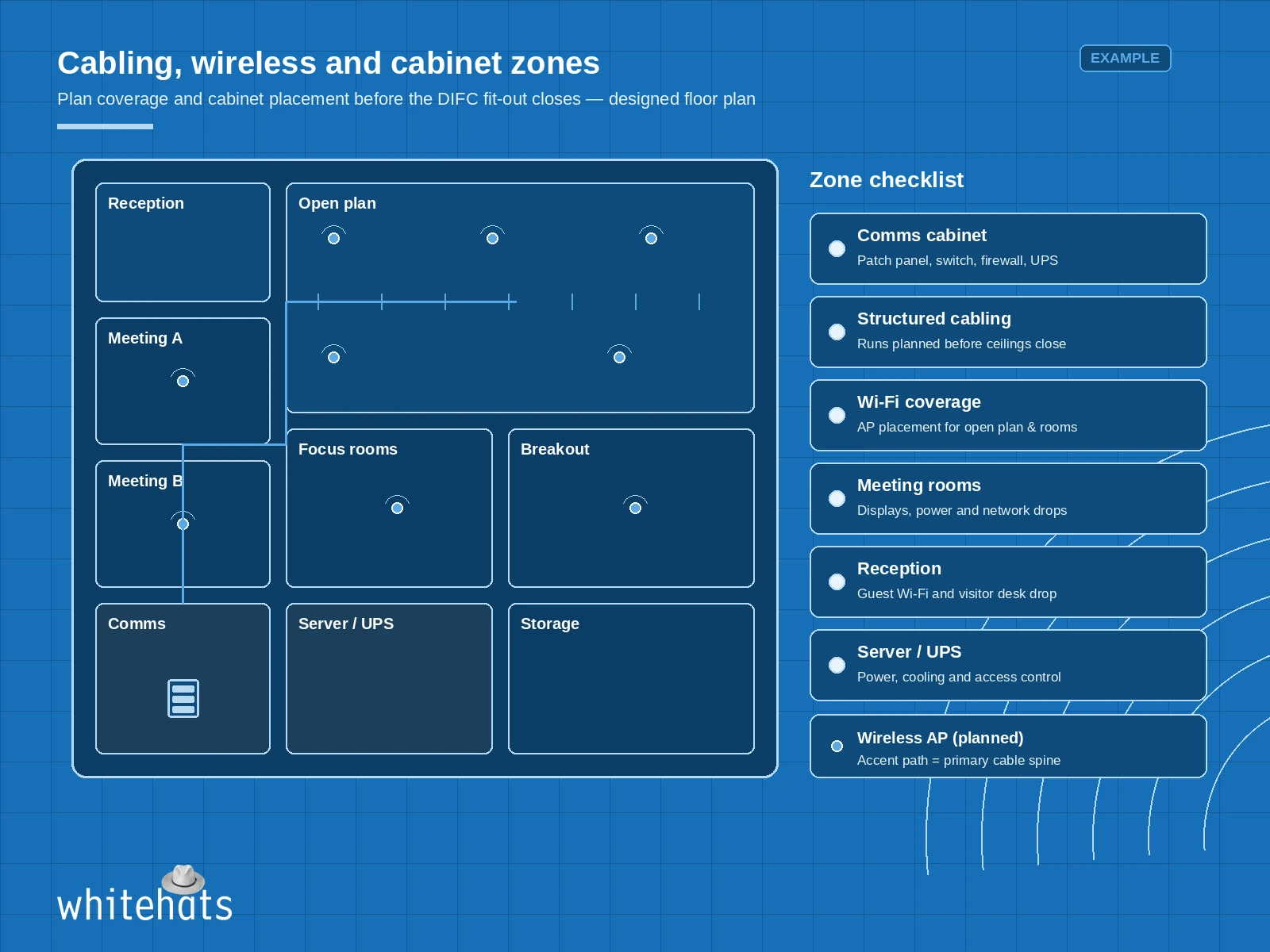
Plan cabling, wireless coverage and cabinet placement before the DIFC fit-out closes.
4. Office relocation in DIFC: moving IT without disrupting operations
Relocating an existing office can be more complex than a greenfield setup. A company moving within Dubai, or transferring regional operations into DIFC, must transfer technology without unnecessary downtime or data loss. Treat relocation as a controlled IT project — not a process of disconnecting equipment and plugging it in elsewhere.
Phase 1: IT infrastructure assessment
Before moving anything, inventory the existing environment:
- Servers and network equipment
- Firewalls and security appliances
- Switches, routers and access points
- Workstations and laptops
- Printers and scanners
- Meeting-room systems
- CCTV and access-control devices
- Internet and telecom services
- Applications, cloud services and dependencies
Document configurations and identify equipment to replace, upgrade or retain.
Phase 2: New office infrastructure design
Assess the new office before relocating equipment: floor plans, network points, cable routes, server-room requirements, wireless coverage, meeting-room layouts and camera locations. Account for employee growth and future expansion.
Phase 3: Relocation and migration planning
Define shutdown and disconnection procedures, data backup and verification, network and IP changes, firewall and VPN changes, internet activation, application and connectivity testing, device transportation and asset tracking, rollback procedures, responsible teams and escalation contacts. For critical operations, consider a staged migration or temporary parallel connectivity rather than moving everything at once.
Phase 4: Installation and commissioning
Install and configure infrastructure once the new office is ready. Test network connectivity, Wi-Fi coverage, VPN access, printers, Microsoft 365, endpoint policies, video conferencing, CCTV and access control before employees start working.
Phase 5: Go-live and post-migration support
The project is not complete when equipment powers on. Finish with user acceptance testing, network performance verification, security validation, asset inventory updates, configuration backups, documentation and handover, plus on-site support during the first working days. Employees should arrive and be able to work, communicate and access corporate systems from day one.
5. DIFC office security: cybersecurity, access control and video surveillance
A modern office needs more than a firewall and antivirus. Plan physical premises security alongside digital infrastructure — especially for financial services, investment firms, legal practices, fintech companies and organisations handling confidential client information.
A comprehensive office security architecture can include network security and segmentation, identity and access management, endpoint detection and response, security monitoring and incident response, physical access control, visitor management, CCTV and video surveillance, and backup and disaster recovery. Plan these systems together, with clear access restrictions and operational responsibilities. Related: Whitehats cybersecurity scope.
Understanding DIFC data protection considerations
Companies operating in DIFC should understand obligations under the DIFC Data Protection Law and applicable regulations. The framework addresses collection, handling and use of personal data.
For an office technology implementation, assess how personal data is collected, accessed, stored, shared and retained — including employee records, visitor information, access logs, CCTV recordings and other information generated by office systems. CCTV and access control should be considered alongside privacy policies and legal obligations.
Installing security technology is not the same as achieving regulatory compliance. Compliance depends on the organisation’s activities, policies, configurations and applicable legal requirements.
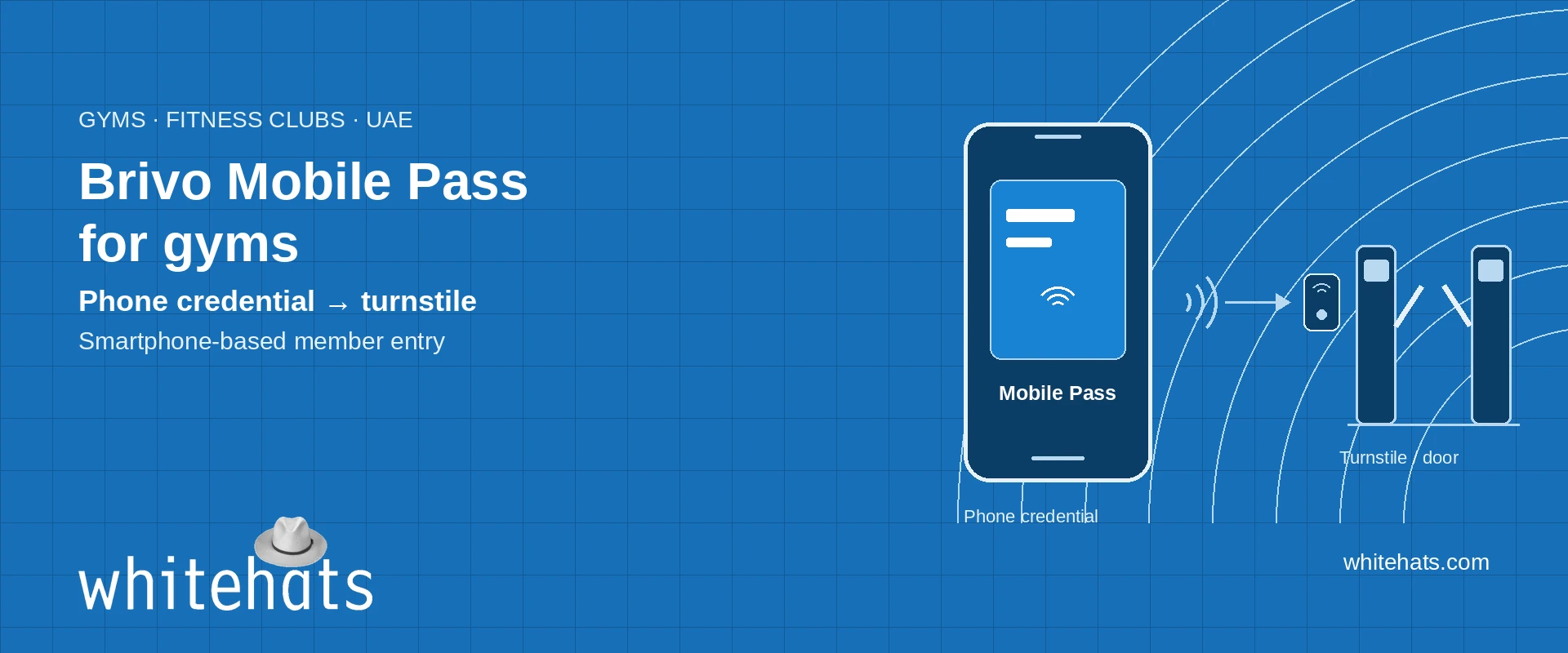
Physical access control with Brivo
Modern businesses increasingly prefer cloud-managed access control over traditional standalone door systems. Brivo is one platform organisations evaluate when planning a modern access-control environment. A Brivo deployment can support:
- Cloud-managed door access
- Centralised user and credential administration
- Access permissions based on roles and schedules
- Remote administration
- Audit trails and access-event visibility
- Multi-location access management, subject to the selected solution
- Integration opportunities with other business systems
For an international company with headquarters in London or New York and an office in DIFC, centralised administration can provide a more consistent way to manage physical access across locations. Select the solution according to door hardware, credential preferences, connectivity, integration needs and local regulatory approvals.
Whitehats plans, deploys and integrates cloud-based access control solutions, including Brivo, subject to project requirements and relevant approvals. See the Whitehats Brivo service page.
Cloud video surveillance with Eagle Eye Networks
Traditional CCTV typically relies on locally managed recording and manual footage retrieval. Cloud-managed video surveillance introduces a different operational model. Eagle Eye Networks provides a cloud video surveillance platform that can support centralised video management and remote access.
Depending on the deployment, capabilities can include centralised camera management, secure remote video access, cloud-managed video operations, video search and investigation, multi-site surveillance management, integration with supported third-party systems, and a scalable video architecture.
For organisations with multiple international offices, centralised visibility helps security teams manage surveillance more consistently. Assess cloud video against bandwidth, retention, camera specifications, data residency and privacy obligations. Related: CCTV planning context.
Brivo and Eagle Eye: a connected security environment
Access control and video surveillance serve different purposes; together they provide useful security context. Access control records when an authorised credential is used. Video provides visual information about activity in monitored areas. Security teams investigate incidents using relevant access and video records. Centralised administration can simplify operations across multiple locations where supported.
Confirm integration possibilities for the selected Brivo and Eagle Eye configurations, licensing and supported interfaces. For companies establishing a DIFC office, the goal is a secure, manageable and documented physical security environment.
6. Is your DIFC office IT setup aligned with global cybersecurity standards?
A Dubai office should not become a weak point in an otherwise mature corporate security environment. If headquarters has implemented Zero Trust principles, endpoint protection, centralised identity management and security monitoring, the regional office should support those standards.
A security-conscious deployment may include:
- Zero Trust access principles — access based on identity, device posture, context and approved permissions
- Network segmentation — separate corporate users, guests, IoT and security infrastructure
- Multi-factor authentication — protect corporate applications and administrative systems
- Endpoint detection and response — deploy and manage controls to global standards
- Centralised monitoring — escalate relevant security events to the right global or regional team
- Secure remote access — approved VPN, identity-aware access or other approved methods
- Backup and recovery — cover critical business data and systems
- Documentation and accountability — clear records of configurations, responsibilities and procedures
Whitehats approaches office deployments from both an operational and a security perspective across infrastructure, cybersecurity and managed IT.
7. What should an international company include in its DIFC IT project budget?
Overseas headquarters often struggle to see what belongs in the local IT implementation budget. A properly scoped project should consider the following categories.
| Project area | Typical requirements |
|---|---|
| Network infrastructure | Firewall, switches, routers, wireless access points |
| Structured cabling | Cat6/Cat6A, fibre, patch panels, racks |
| Connectivity | Business internet, backup connection, static IP |
| IT hardware | Laptops, desktops, docking stations, peripherals |
| Microsoft infrastructure | Microsoft 365, Entra ID, Intune |
| Cybersecurity | Endpoint protection, MFA, monitoring, security policies |
| Meeting rooms | Teams Rooms, Logitech, displays, microphones |
| Physical security | Access control, door hardware, visitor management |
| Surveillance | CCTV cameras, recording and cloud video management |
| Infrastructure protection | UPS, power management and backup |
| IT support | On-site support, remote assistance, maintenance |
The final bill of materials depends on headcount, floor area, business activity, security requirements, corporate IT standards and the intended operating model. An infrastructure assessment before procurement prevents unnecessary spend and reduces the risk of missing essential components.
8. Choosing the right IT infrastructure partner in DIFC
For an overseas company, choosing an IT partner in Dubai is not simply finding someone who can install network equipment. The partner should understand how international IT departments operate. Before appointing an implementation partner, ask:
- Have they implemented IT infrastructure for companies in DIFC?
- Can they work directly with an overseas IT department?
- Can they follow an existing corporate architecture and security policy?
- Do they provide networking, cybersecurity and endpoint management?
- Can they implement meeting-room and collaboration systems?
- Do they support cloud-based access control and surveillance?
- Can they manage complete office IT relocations?
- Do they provide documentation and structured handovers?
- Can they provide ongoing local support after the project?
- Can they manage multiple technology vendors under one project?
A partner that understands the complete technology environment reduces vendor count, simplifies coordination and clarifies operational accountability. For day-to-day support models, see Whitehats IT support in Dubai.
9. Why international companies work with Whitehats on DIFC IT projects
Whitehats is an IT infrastructure, cybersecurity and managed services provider based in Dubai, UAE. Services cover the complete lifecycle of office technology projects:
- IT infrastructure design and implementation — network architecture, structured cabling, firewalls, Wi-Fi and server-room setup
- Office IT relocation — structured migration procedures and business continuity considerations
- Cybersecurity and Zero Trust — identity security, endpoint protection, network security and access controls
- Microsoft cloud and infrastructure — Microsoft 365, Entra ID, Intune, security configurations and cloud infrastructure services
- Physical security solutions — cloud-based access control, Brivo solutions, Eagle Eye Networks video surveillance and associated infrastructure
- Meeting-room and collaboration technology — professional deployments using Logitech and other enterprise collaboration technologies
- Managed IT support — local technical assistance, maintenance, monitoring and ongoing IT operations support
Whitehats works as an extension of your internal IT department: following corporate standards while providing the local technical resources required to make the Dubai office operational. Whether you are opening a new DIFC office, moving an existing operation, upgrading infrastructure or appointing a reliable local technology partner, Whitehats coordinates planning through implementation and ongoing support.
10. Frequently asked questions
Speak with Whitehats
If your company is establishing a presence in DIFC, relocating from another Dubai business district or expanding regional operations, involve your IT infrastructure partner early. Request a DIFC IT infrastructure consultation for complete office IT setup, structured relocation, enterprise networking, cybersecurity, Brivo access control, Eagle Eye video surveillance or ongoing managed IT support.
UAE companies with 20+ staff can request a free onsite IT Support & Security Assessment.
Contact: contact Whitehats | +971 4 338 2500
Whitehats LLC — Al Quoz 3, Dubai, UAE