SIRA Approved CCTV Dubai
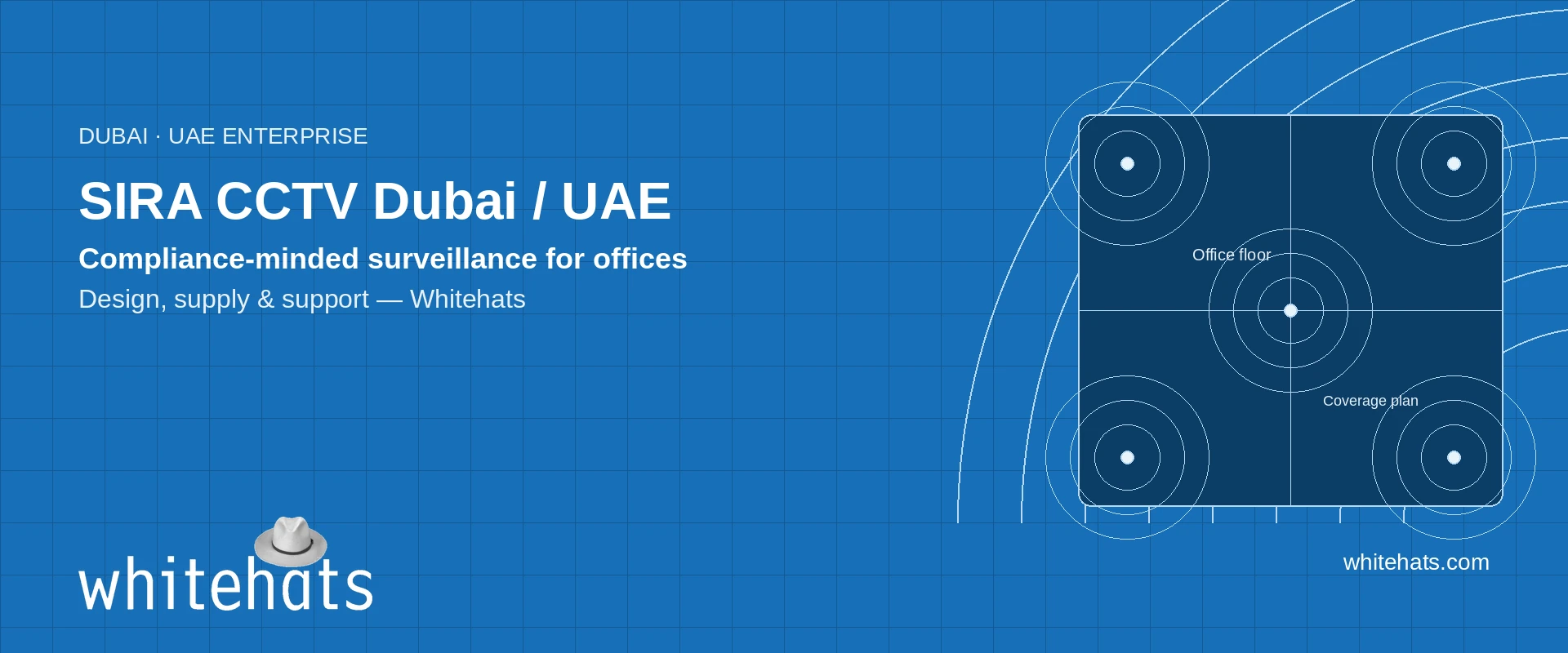
Dubai commercial and regulated premises need more than a popular camera brand. SIRA-ready CCTV design starts with model-specific approved equipment, a security plan and audit path where the facility requires it, and an IP architecture that covers recording, networking and secure operations – not the question “is Brand X SIRA approved?” Whitehats LLC supports organisations across the UAE with security technology, network IT solutions in Dubai, storage and cybersecurity services in Dubai around CCTV, video recording and access control.
Approved camera != approved installation.
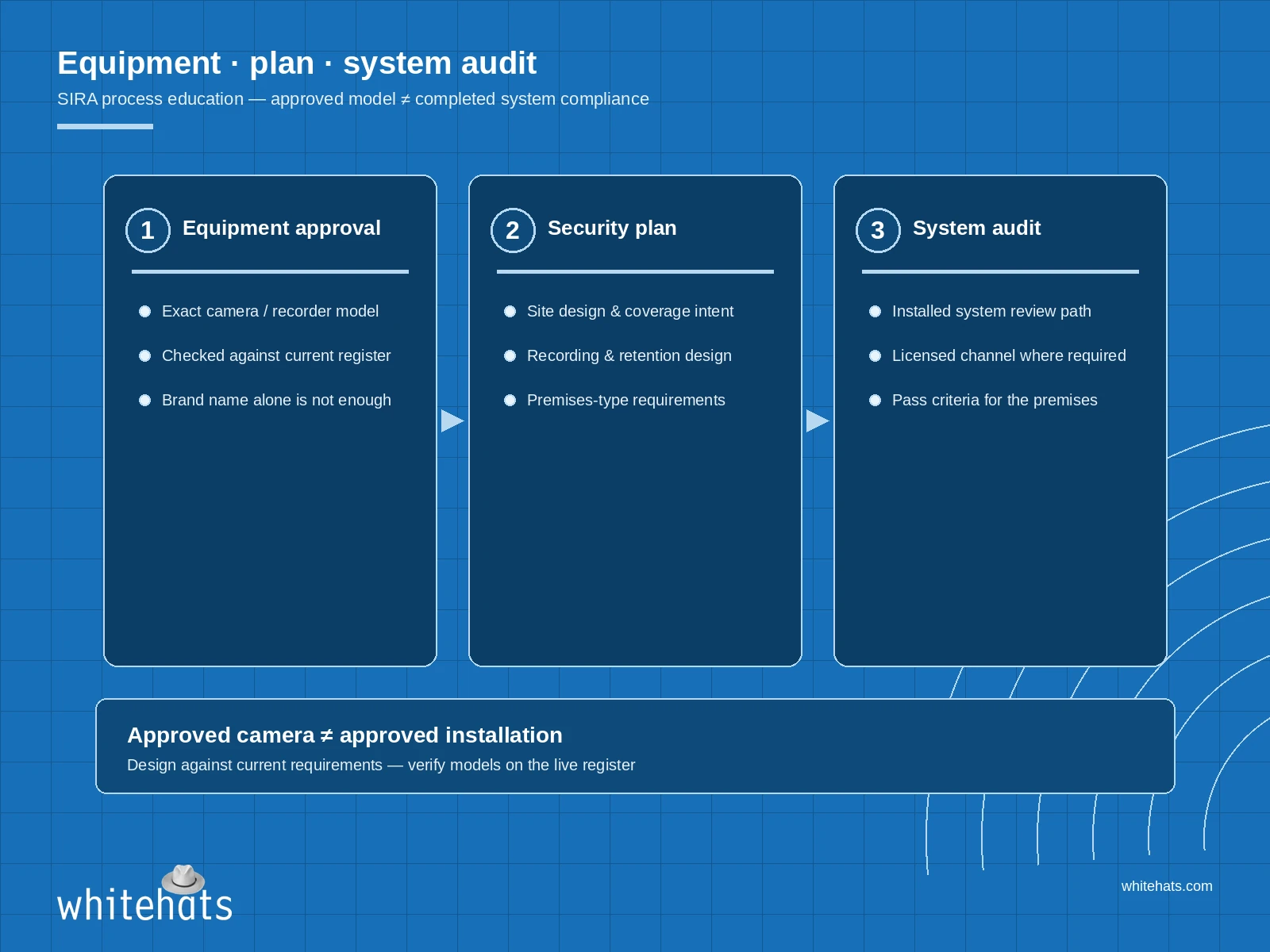
SIRA equipment approval is model-specific. A complete Dubai project typically also needs a security plan, installation through the appropriate licensed security-system channel where required, and a successful security audit before the installed system can be treated as certified. Buying an approved camera alone does not make the installation compliant.
Call +971 4 338 2500 or request a SIRA-ready assessment for your facility.
Jump to: What SIRA-approved means · Requirements · Approved brands & model examples · Camera types · AI & ANPR · Recording / NVR / VMS · Storage · Network & cyber · Access control · Plan vs system cert · Industries · Why Whitehats · Process · FAQ
What SIRA-Approved CCTV Means in Dubai
SIRA (Security Industry Regulatory Agency) regulates the security industry in the Emirate of Dubai and sets requirements for security systems and equipment. For buyers, the critical distinction is simple: a SIRA-approved camera is not the same thing as a SIRA-approved security installation.
SIRA maintains approved-equipment records and technical specifications for devices such as cameras and recording platforms. Separately, security-system certification addresses the installed system – plan, installation path, audit and conformity with applicable specifications.
Before procurement, the better questions are:
- Is the exact camera model approved against the current register?
- Is the exact recorder / NVR / VMS model or software approved where applicable?
- Does the proposed design meet current SIRA technical specifications?
- Is a security plan required – and is it approved?
- Is installation proceeding through the appropriate licensed security-system channel where required?
- Will the completed installation be ready for the required security audit?
- Do coverage, recording and operations match the premises type?
Brand popularity does not answer those questions. Model verification, design and process do.
SIRA CCTV Requirements from the Preventive Systems Manual
SIRA’s current Preventive Systems Manual (issued under Administrative Resolution No. 13 of 2025 in current SIRA material) sets technical specifications for digital / IP surveillance systems. The themes below are drawn from that manual; always confirm the edition that applies to your project before you specify equipment. Model examples later in this article are illustrative of names that have appeared in SIRA-approved records – they are not a substitute for checking the live official register.
| Theme | What the current manual emphasises |
|---|---|
| Resolution | Colour IP cameras with a minimum Full HD 1080p resolution – megapixel marketing alone is not a compliance shortcut. |
| Outdoor protection | Outdoor cameras or enclosures with a minimum IP66 rating for continuous outdoor use. |
| Wide Dynamic Range | Suitable WDR where cameras face strong natural or artificial light – the current manual specifies at least 110 dB or equivalent for relevant installations. |
| Night imaging | Infrared capability where night viewing is required. |
| Height / optics | Remote zoom / focus for cameras installed at 4 metres or above. |
| Recording behaviour | Digital recording with simultaneous live view, record and playback; continuous and event-based modes; export and search; time sync; failure notifications; ONVIF / RTSP support among other operational rules. |
| Cabling | High-quality cabling; copper-clad aluminium and copper-clad iron not allowed; twisted-pair runs at least CAT6 where twisted pair is used; connections protected against tampering. |
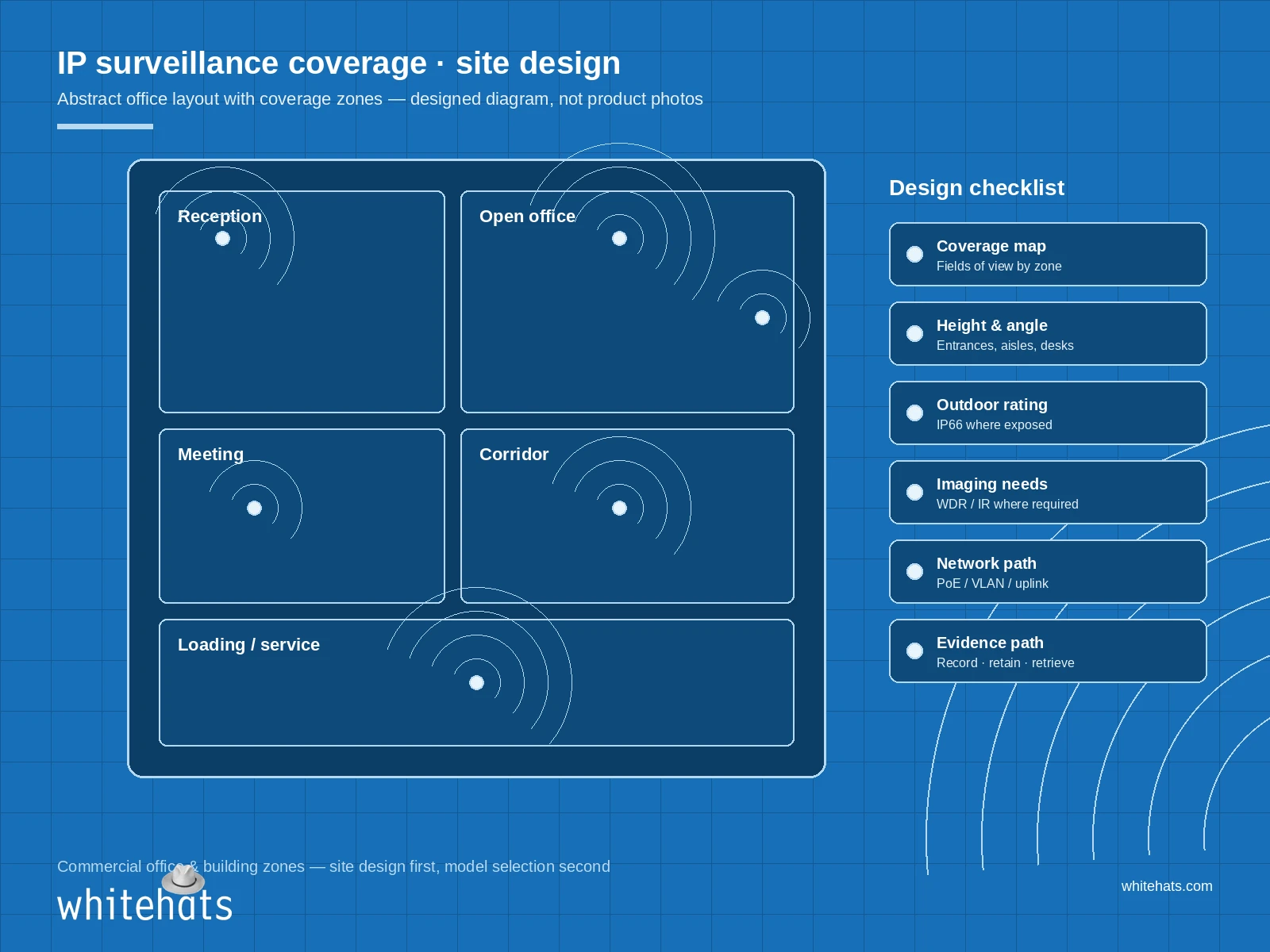
Selecting a camera solely on “4MP / 8MP / 4K” is not enough. The camera must match the surveillance objective (detection, monitoring, observation, recognition, identification, inspection, licence-plate viewing) and the site conditions.
SIRA-Approved Camera Brands & Model Examples
SIRA’s approved-camera list contains a large number of manufacturers and individual camera models. Approval is model-specific. A brand appearing in SIRA records does not mean every current camera sold under that brand is approved. Model lists also change – verify the exact model number and applicable SIRA approval reference against current official SIRA records before procurement. The examples below are drawn from source documentation of models that have appeared in SIRA-approved camera records; they are educational examples, not permanent approval stamps.
Hikvision
The SIRA list contains numerous Hikvision camera models, including newer models such as:
- DS-2CD3663G2-IZS
- DS-2CD3061G2E-LIU
- DS-2CD3761G2-LIZSU
- DS-2CD2747G2H-LIPTRZS
- iDS-2CD7A47G2-XZHS
- DS-2CD2087G3-LI2UY
- DS-2CD2047G3-LI2UY
…and many other approved models. Confirm each SKU against the live register before specification.
Dahua
The SIRA approved list includes numerous Dahua cameras, including:
- DH-IPC-HDBW3441R-ZS-S2
- DH-IPC-HFW2449S-S-IL
- DH-IPC-HDBW5541E-ZE
- DH-IPC-HFW2541T-ZS
- DH-IPC-HDBW2541R-ZS
- DH-IPC-HDW1230T1
- DH-IPC-HFW1230S1
- DH-IPC-HUM8441E-E1
…among many other models. Exact model verification remains mandatory.
Axis Communications
SIRA’s approved camera list also includes Axis models such as:
- AXIS Q6125-LE
- AXIS P1377
- AXIS P9106-V
- AXIS M3115-LVE
- AXIS Q1615 MK III
- AXIS Q1656
- AXIS P1468-LE
- AXIS Q9216-SLV
- AXIS Q6215-LE
- AXIS Q3626-VE
…among other approved models. Match the model to the surveillance objective and confirm current approval status.
Hanwha Vision
The SIRA list contains a substantial number of Hanwha Vision / Wisenet models, including series such as:
- XND series
- XNO series
- XNP series
- XNV series
- QND series
- QNO series
- QNV series
- SNB series
- SND series
Individual model approvals are recorded by SIRA – verify the specific SKU, not only the series letter.
Bosch
Bosch is also represented in the SIRA-approved camera list, including:
- DINION IP 5000i
- FLEXIDOME IP indoor 4000i
- FLEXIDOME IP indoor 5000i
- FLEXIDOME IP indoor micro 3000i
- DINION IP 3000i TURRET
- FLEXIDOME IP 3000i
…and additional Bosch models. Confirm the exact product against current records.
Honeywell
Honeywell cameras also appear in the SIRA approved camera records, including models from its H4W, HBW and HEW families. Family membership is not brand-wide approval – check the exact model number.
Avigilon, Pelco and other manufacturers
The current SIRA list also contains products from manufacturers and security technology companies including:
- UNV
- Avigilon (including models associated with Motorola Solutions)
- Pelco
- Tyco / Illustra
- CP PLUS
- VNS
- Comelit
- TGENFIVE
- Provision-ISR
- Motorola Solutions
- CITA
- March Networks
- Huawei
- Longse
- Vanguard
- Infinique
…and other manufacturers. For example, the current list includes Avigilon models from Motorola Solutions and recent Hanwha Vision models. Where the source lists brand presence without a full SKU dump, treat the brand as an overview entry and verify any candidate model on the official register.
Popular CCTV & video surveillance brands evaluated in the UAE
Depending on project requirements, budget, application and SIRA approval status, UAE customers commonly evaluate security technology from brands including:
Hikvision · Dahua · Axis Communications · Hanwha Vision · Bosch · Honeywell · Avigilon · Pelco · UNV · Tyco / Illustra · CP PLUS · Vivotek · Panasonic · Johnson Controls
The correct brand should not be selected simply because it is popular. For a Dubai SIRA project, the actual question is: which specific product and system architecture meets the project’s technical, operational and regulatory requirements?
Before you raise a PO:
- Confirm the exact model (and recorder / VMS where needed) against the current official SIRA approved-equipment register.
- Confirm the model still fits the technical specifications and the site’s surveillance objective.
- Confirm current UAE availability for the selected configuration.
Whitehats selects equipment against current registers as part of SIRA-ready design – not by assuming brand-wide approval.
Choosing the Right Camera Type
Different locations need different form factors. Use this chooser as a design starting point; final selection still depends on objective, lighting, mounting height and approval status.
| Type | Typical objective | Notes |
|---|---|---|
| Fixed dome | Offices, retail floors, hotel lobbies, corridors, reception | Discrete indoor coverage; vandal-resistant options where needed. |
| Bullet | Perimeters, façades, parking, loading bays, warehouse approaches | Visible deterrent; often preferred outdoors with IR and weather rating. |
| Turret | Offices, retail, warehouses, commercial interiors | Flexible mounting; less dome-glare than some enclosed designs. Soft residential mention only – prefer commercial framing. |
| PTZ | Large compounds, parking decks, industrial yards, long outdoor spans | Operator-led pan / tilt / zoom; pair with fixed cameras for continuous coverage. |
| Long-range | Perimeter and critical outdoor approaches | Lens and pixel-density design matter more than megapixel claims. |
| Fisheye / multi-sensor | Wide open interiors, atriums, large halls | Fewer cameras for wide coverage; dewarping and VMS support required. |
| ANPR / LPR | Vehicle gates, logistics yards, parking, restricted vehicle access | Not a standard CCTV camera – lighting, angle, speed and recognition workflow matter. |
| Thermal (where scoped) | Perimeter detection in low-light / long-range detection roles | Complements, rather than replaces, colour identification cameras. |
AI Video Analytics and ANPR
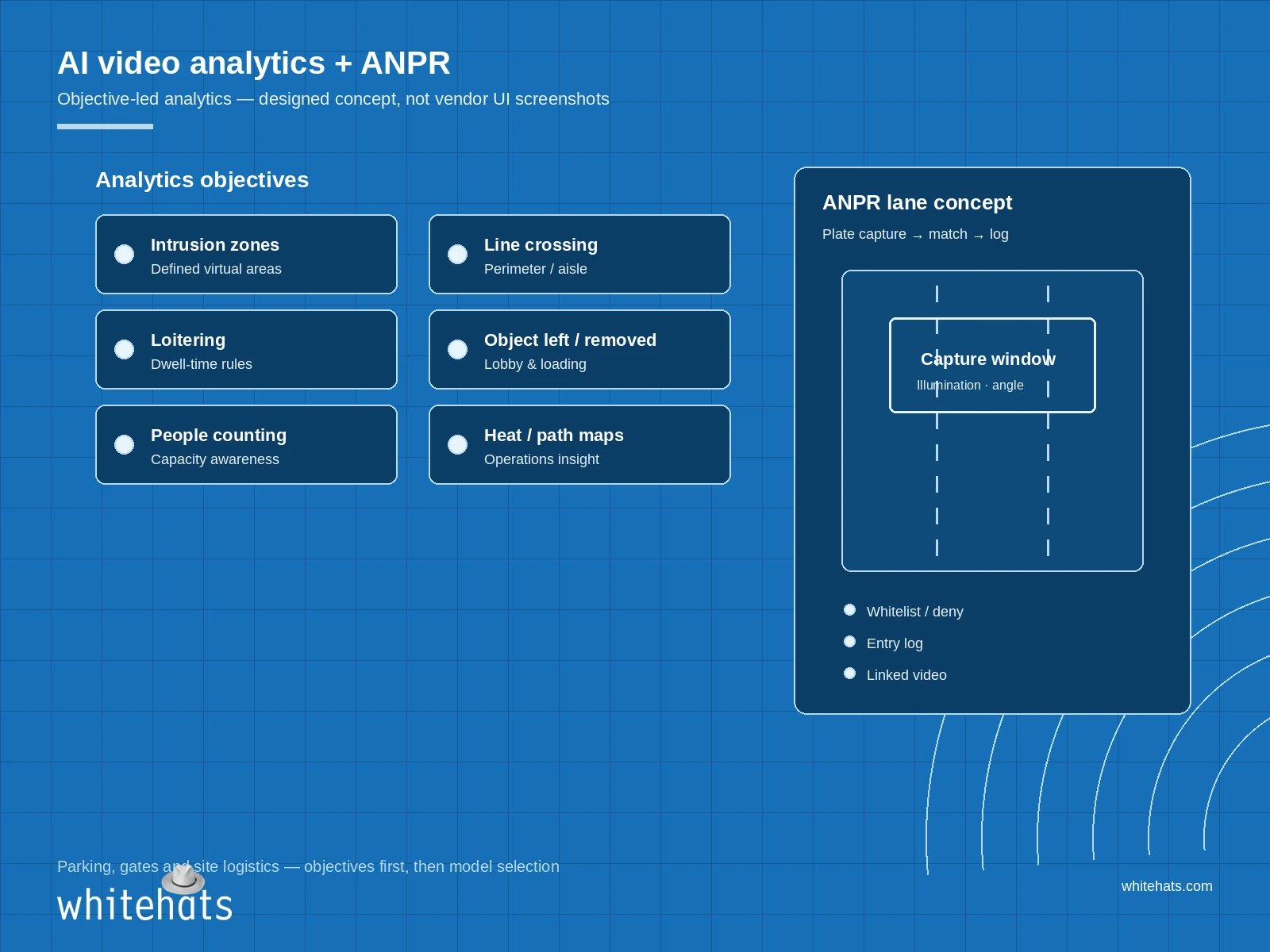
Modern platforms can add analytics – but analytics should follow security objectives, not a product sheet checklist.
Depending on the platform and licence, AI-enabled surveillance may support person and vehicle detection, intrusion and line-crossing, loitering, object detection, people or vehicle counting, abandoned-object / unattended-object detection, smart search, heat mapping, crowd monitoring and related behavioural analytics. Face detection and related features must be scoped carefully against privacy, governance and premises policy.
Design by objective examples:
- Warehouse perimeter – intrusion and line-crossing analytics with PTZ follow-up where useful.
- Retail – people counting, queue and exception analytics at entrances and POS approaches.
- Parking / logistics – vehicle analytics plus ANPR at controlled gates.
- Commercial communities – perimeter detection, visitor workflows and vehicle access rules.
ANPR projects need more than an “ANPR-labelled” camera: capture quality, lighting, plate angle, lane geometry, blacklist / whitelist logic and integration with barriers or access control all belong in the design.
The goal is an intelligent security system – not purchasing an “AI camera” as a label.
Recording: NVR vs DVR vs VMS
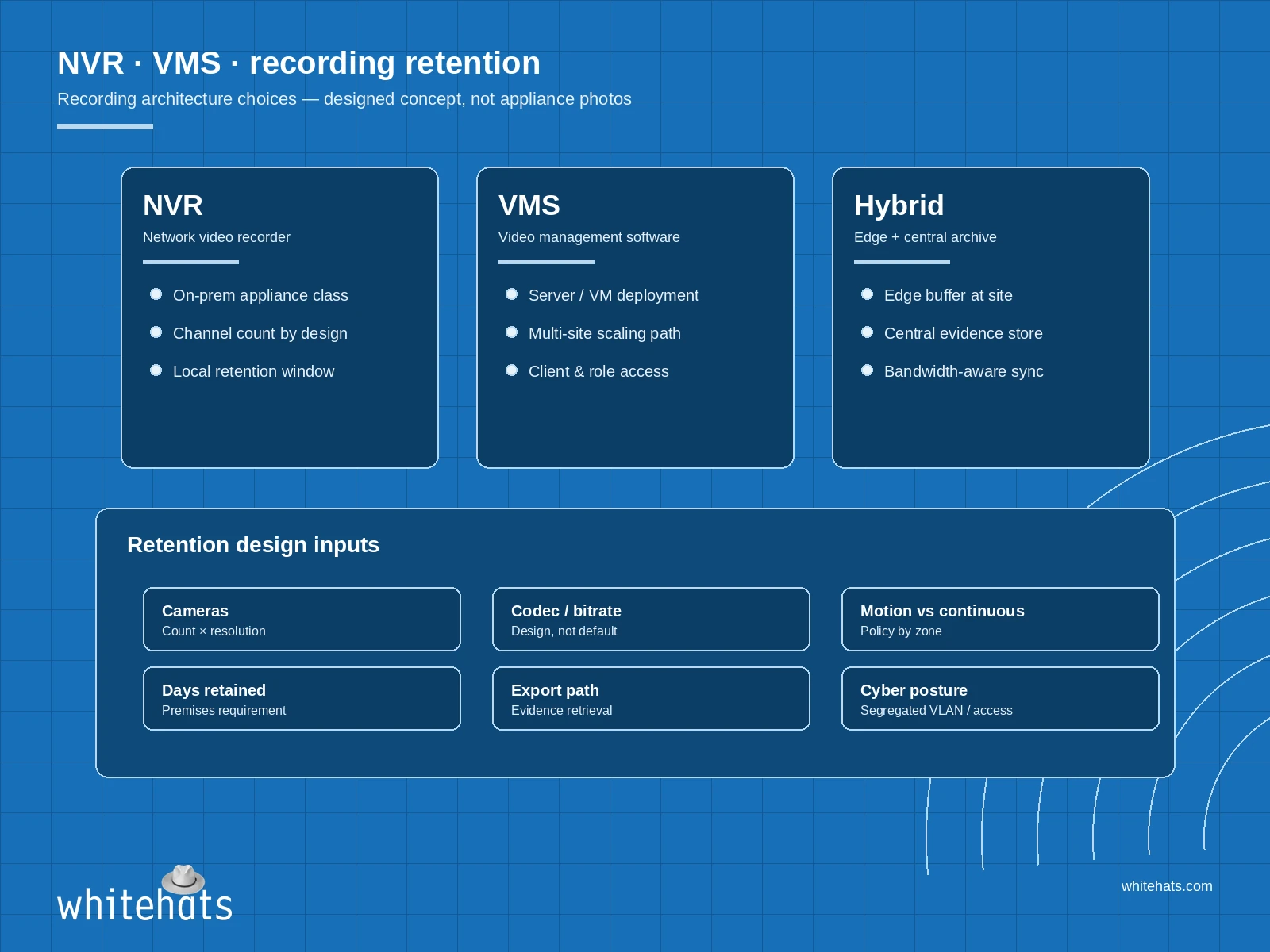
The recording platform is as important as the camera. Channel count alone is a poor selection criterion. Architecture should follow camera count, resolution, frame rate, bitrate, retention, redundancy, export and operator workflow.
SIRA’s current technical specifications require digital recording devices and specify requirements including minimum 1080p recording, appropriate live-view resolution, simultaneous live viewing / recording / playback, at least 25 frames per second for live view, export/copy functionality, efficient search, continuous and event-based recording, pre- and post-event recording, additional storage capability, date/time display, automatic recovery after restart, ONVIF compatibility, RTSP support, NTP/time synchronisation, storage-failure and camera-failure notifications, user login identification, and standard or supported export formats – among other operational rules. Confirm the edition that applies to your project.
NVR vs DVR
| Platform | When it fits | Notes |
|---|---|---|
| NVR (Network Video Recorder) | New IP CCTV estates | High-resolution IP video, PoE connectivity options, network-based architecture, easier expansion, advanced analytics, remote management, integration with VMS, easier deployment across larger networks. Generally preferred for new digital installations. |
| DVR (Digital Video Recorder) | Existing analogue / coax estates, hybrid upgrades, cost-sensitive replacements | Traditionally used with analogue/coaxial CCTV. Still relevant for legacy cabling and hybrid environments; new-build IP designs usually favour NVR or VMS. |
| VMS (Video Management System) | Multi-site, multi-operator, enterprise estates | Centralised camera management, user permissions, video search, event management, alarm integration, video analytics, access-control integration, maps, operator workstations, evidence export, central monitoring and health monitoring. |
SIRA-approved NVR, DVR & VMS manufacturer overview
SIRA also maintains approved records for recording and VMS solutions. The current SIRA recorder/VMS list includes examples from:
- Hikvision
- Dahua
- Honeywell
- Hanwha
- Bosch
- Genetec
- Pelco
- CP PLUS
- D-Link
- Snappy
- Securos
- MXHelix
- Instek Digital
…and other manufacturers/platforms. For example, the current SIRA recorder list contains approved Hikvision NVR/DVR models, Dahua NVRs, Honeywell solutions, Genetec Security Center and Pelco VideoXpert solutions. Again, the exact recorder/VMS model or software version must be verified before specifying it for a SIRA-regulated installation.
Enterprise video management systems
Enterprise platforms commonly encountered in UAE security projects include:
- Genetec Security Center
- Milestone XProtect
- Avigilon Unity / Alta
- Bosch BVMS
- Axis Camera Station
- Hanwha Wisenet solutions
- Hikvision HikCentral
- Dahua DSS
The specific platform and version should be checked against project requirements and applicable SIRA approval requirements before being specified for a Dubai-regulated project.
Where organisations evaluate cloud-managed video, architecture choice (on-premises, hybrid or cloud) still has to respect retention, network path and regulatory expectations. Whitehats can discuss Eagle Eye Networks cloud VMS as one cloud path when that model fits – without treating cloud branding as a substitute for SIRA readiness.
Need recording architecture sized to retention and camera count? Call +971 4 338 2500.
Storage and Retention Design
Video retention is a design input, not an afterthought. SIRA’s current Preventive Systems Manual includes a minimum 31-day requirement for the specified motion-activated recording configuration, plus related capacity and expandability rules. Confirm the retention and recording mode that apply to the specific premises / activity – do not assume one number fits every project.
Storage sizing should consider:
- Camera count x resolution x FPS x bitrate x recording hours x retention x recording mode
- Overhead for motion peaks, analytics metadata and growth
- Redundancy so evidence remains available when an incident occurs
For larger estates, treat storage as security infrastructure: surveillance-grade HDDs, multi-bay NVR or server storage, RAID and hot-spare where justified, NAS / SAN or centralised VMS storage, edge recording, and hybrid storage where the design needs it. Whitehats designs storage around the actual camera configuration rather than generic calculator assumptions.
Network and Cybersecurity for CCTV
A strong camera cannot fix a weak network. IP CCTV is an IT system: cameras, NVRs, VMS servers and access controllers are networked endpoints.
Typical design elements for SIRA-oriented projects include dedicated surveillance VLANs, managed PoE switching, fibre uplinks where distance or bandwidth requires it, CAT6 structured cabling (per current manual themes), redundant paths where uptime matters, QoS where appropriate, UPS protection, firewall controls and secure management planes – as part of broader network IT solutions in Dubai.
Cybersecurity considerations for surveillance estates include strong credentials, MFA where supported, network segmentation, firmware lifecycle, role-based access, logging, encryption in transit where supported, backup of configuration and evidence workflows, and controlled vendor remote support. A network security audit is often the right first step when an existing camera network has grown organically.
Remote access should not mean exposing an NVR directly to the internet. A safer pattern is:
Authorised user -> MFA (where supported) -> secure VPN or zero-trust access -> firewall -> VMS / NVR -> cameras
Whitehats folds physical security technology into the same cybersecurity services in Dubai posture used for office IT – especially when multi-site viewing or mobile operator access is required.
Cloud CCTV vs on-premises vs hybrid
UAE organisations increasingly evaluate cloud-managed security platforms alongside on-premises recording.
| Approach | Potential advantages | Design note |
|---|---|---|
| Cloud-managed | Centralised management, remote administration, multi-site visibility, easier scaling, reduced local infrastructure, cloud analytics | Still must respect retention, network path and regulatory expectations |
| On-premises | Local control, local recording, existing infrastructure compatibility, greater control over storage architecture | Often preferred where data locality or specific operational rules apply |
| Hybrid | Local recording + secure cloud management + central monitoring | Common practical pattern for multi-site estates |
The correct approach depends on regulatory / SIRA requirements, data sensitivity, network availability, retention requirements, number of sites and the operational model.
Access Control and CCTV Integration
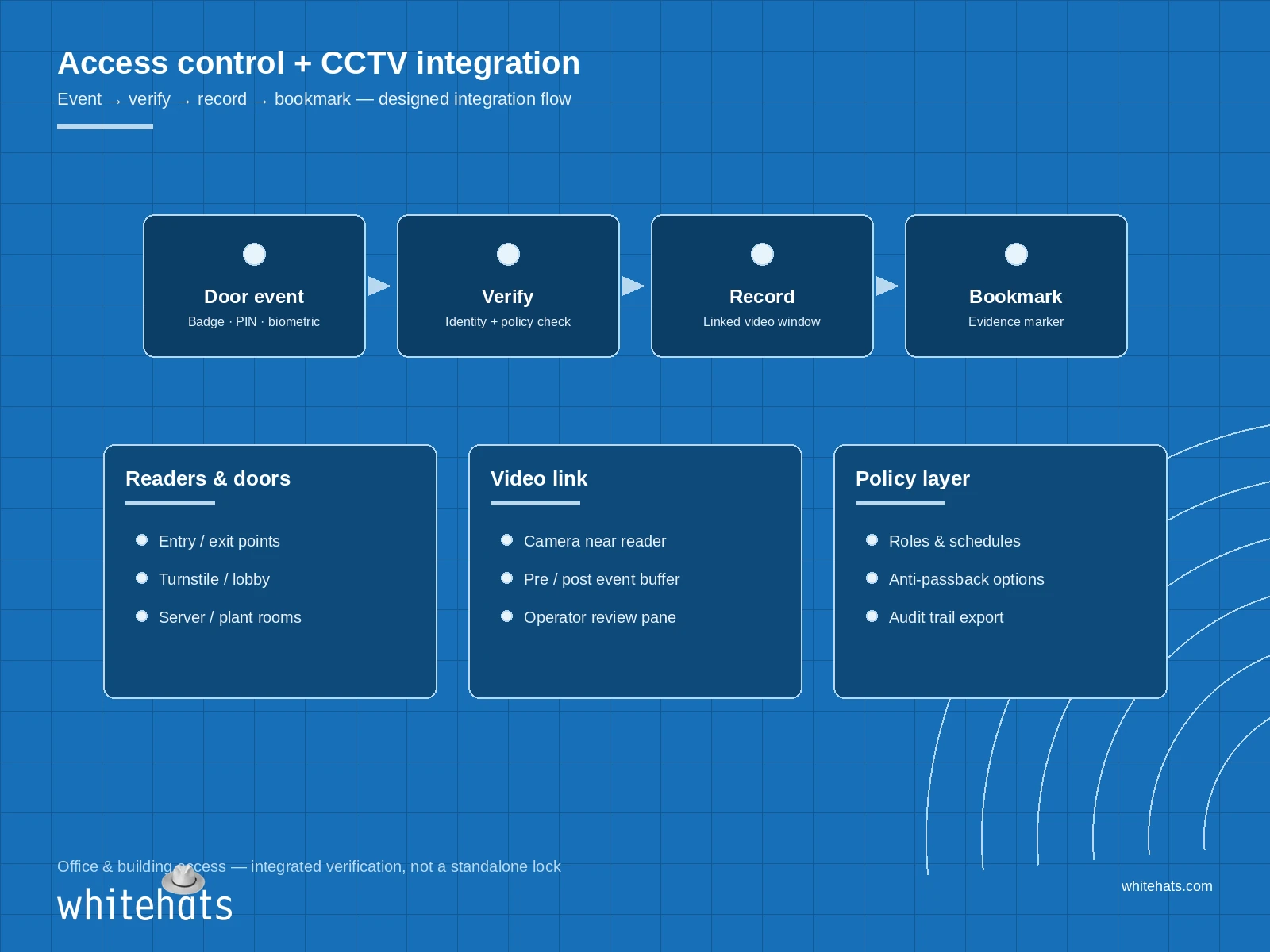
CCTV shows what happened. Access control answers who was authorised to enter, which door opened, when, and with which credential.
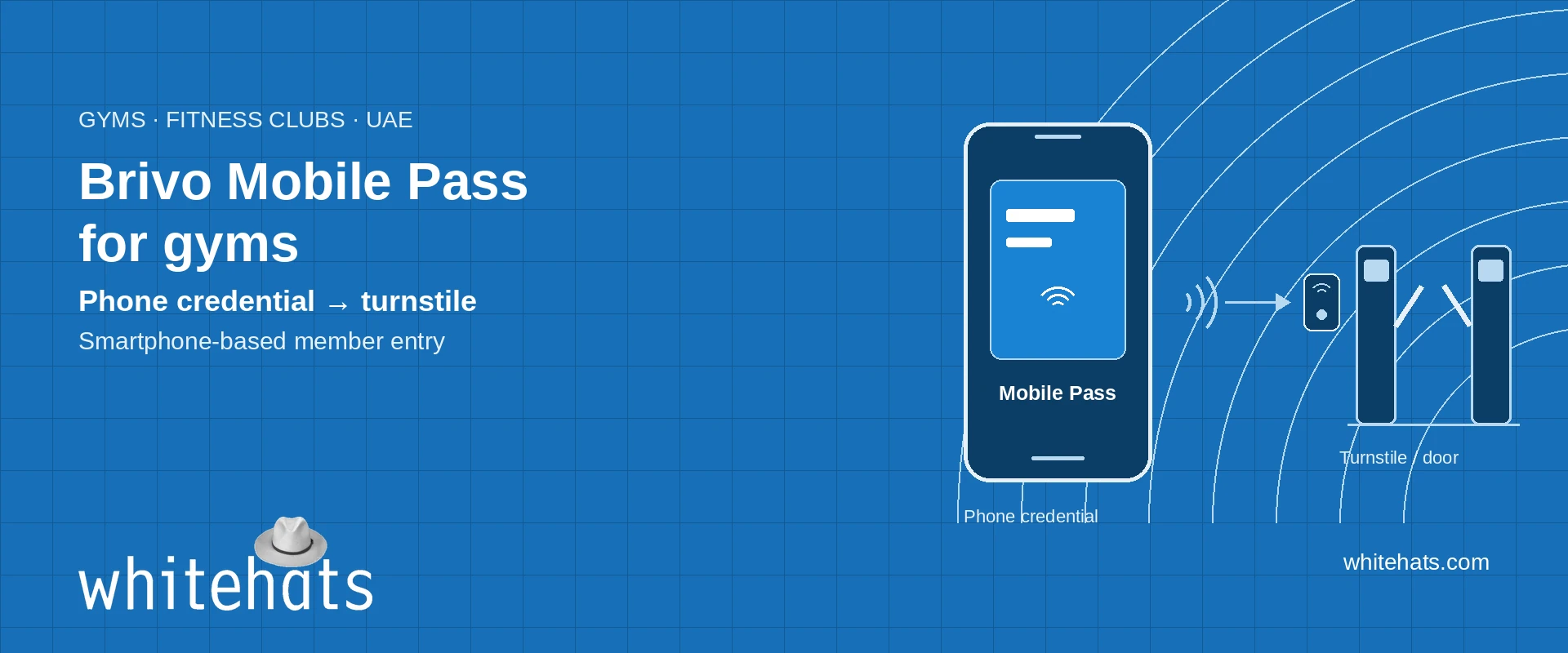
Modern access architectures may include door controllers, card / RFID / smart-card readers, PIN, fingerprint or facial biometrics, palm or iris recognition where scoped, mobile credentials, QR codes, visitor management, turnstiles, speed gates, barriers, automatic gates, elevator access, vehicle access and intercom integration – subject to privacy and governance for biometric data.
Enterprise / high-security platforms commonly evaluated: HID Global, Gallagher, Johnson Controls / CCURE, LenelS2, Honeywell, Bosch, Genetec, Axis Communications, Suprema, Dormakaba.
Commercial / SMB / integrated access platforms commonly evaluated: Hikvision, Dahua, ZKTeco, Suprema, Bosch, Honeywell, Axis, Johnson Controls, Brivo, HID, Dormakaba.
That list is not a claim that every product from those manufacturers is SIRA approved; verify controllers, readers and software against current requirements. SIRA’s Preventive Systems Manual includes a dedicated Access Control Systems chapter.
Integration with video strengthens the audit trail:
| Step | What happens |
|---|---|
| Event | Credential presented at the door or gate |
| Verify | Controller validates authorisation and unlocks (or denies) |
| Record | Associated CCTV stream captures the transaction |
| Bookmark / alert | Operator notification, camera pop-up, video bookmark, lockdown or response workflow where configured |
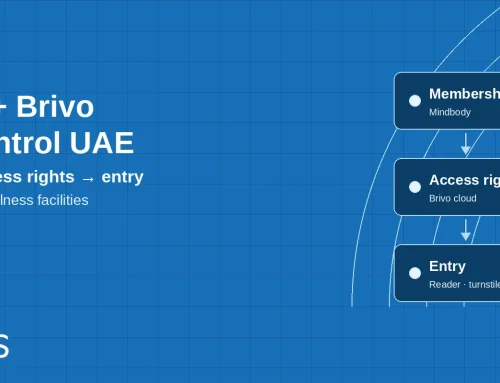
For higher-security zones, a practical stack combines credential + PIN or biometric + door monitoring + CCTV verification. Cloud access and video options such as Brivo cloud video surveillance can be evaluated where the operating model fits – again with model and regulatory checks, not brand assumptions.
Planning access control with video event correlation? Call +971 4 338 2500.
Equipment Approval vs Security Plan vs System Certification
This trust section is the heart of SIRA CCTV buying decisions in Dubai.
| Path | What it means | What it does not mean |
|---|---|---|
| Equipment approval | SIRA examines and approves specific devices / models (cameras, recorders and related security equipment) against applicable specifications. Technical documentation and a device sample may be required as part of equipment certification. | Brand-wide approval of every SKU the manufacturer sells. |
| Security plan certification | For applicable facilities, SIRA’s Security Plans Certification process approves the security-system plan, with documentation such as trade licence, planning map and project plans among required inputs for camera/alarm security plans. | “Supply -> install -> switch on cameras” without design documentation. |
| Security system certification / audit | Accreditation of conformity for the installed system – typically requiring an approved security plan certificate and a successful security audit report for applicable commercial establishments. SIRA states the activity should not proceed until a successful audit report has been obtained where that process applies. | That any single approved camera automatically certifies the whole estate. |
Buying a SIRA-approved camera does not automatically make the complete CCTV installation SIRA compliant.
Whitehats frames its role as SIRA-ready design, equipment selection against current registers, and technology / IT / cyber delivery that works with the licensed security-system channel where required – without inventing a Whitehats SIRA licence number, “approved installer” badge or “certified partner” seal.
CCTV Design Based on Security Objectives
Whitehats recommends designing surveillance around the required viewing objective, rather than simply selecting cameras based on megapixels. SIRA’s current manual distinguishes between surveillance objectives such as:
- Detection – determine that something is present
- Monitoring
- Observation
- Recognition – determine whether a person is someone already known
- Identification – capture sufficient detail to identify an unknown person
- Inspection
- Licence-plate viewing (ANPR) – capture a vehicle licence plate with suitable detail
These objectives determine camera positioning, lens selection, resolution, pixel density and field of view. The correct camera for one objective may be completely unsuitable for another.
Commercial and Regulated Premises
This pillar focuses on commercial, community and regulated premises across Dubai and the UAE – offices, warehouses, hotels, retail, education, financial sites and other regulated facilities rather than villa or home systems.
Offices – entrance and reception coverage, corridors, server-room access control, visitor management, door monitoring, NVR / VMS and employee access control.
Retail – customer-area and POS approaches, entrance / exit cameras, stock-room access, people-counting or exception analytics where useful.
Warehouses & logistics – perimeter and dock cameras, long-range and PTZ roles, intrusion analytics, vehicle monitoring, ANPR at gates, access control and centralised recording.
Hotels – lobby, reception, parking, service entrances, back-of-house and lift approaches, access control, visitor workflows and control-room / VMS operations. The Preventive Systems Manual includes dedicated requirements for luxury and tourist hotels.
Schools & educational facilities – perimeter surveillance, entrance control, visitor management, parking and central monitoring, aligned to the manual’s education chapter where applicable.
Financial and other regulated commercial premises – higher emphasis on controlled entry, audit trails, recording integrity and operator procedures.
Healthcare facilities (premises security only) – entrance, reception, parking, pharmacy and restricted-area physical security, access control and visitor management as facility security, not medical-IT, clinic systems or patient-care technology. The manual includes a healthcare facilities chapter; treat it as premises regulation, not a medical device conversation.
Data centres – layered physical security: perimeter -> CCTV -> access control -> mantrap / biometric zones -> rack or zone controls -> VMS -> security operations, consistent with the manual’s data-centre themes.
Why Whitehats for SIRA-Ready CCTV
Modern CCTV is an IP technology environment: cameras + network + storage + servers + cybersecurity + access control + monitoring + data. Whitehats combines security technology with the IT and cyber layers those systems depend on – so camera estates are not designed as an island.
Whitehats supports customers with:
- Security system design – site assessment, coverage objectives, camera positioning and architecture
- SIRA-ready planning support – documentation and design aligned to applicable requirements
- Equipment selection against current registers – model verification before specification
- CCTV and recording supply – cameras, NVR / VMS, storage and accessories subject to availability
- Access control – card, biometric, mobile and integrated door / gate environments
- Network infrastructure – PoE switching, structured cabling, fibre and secure segmentation
- Cybersecurity – firewalls, identity, endpoint and secure remote-access patterns
- Integration – CCTV with access control, ANPR, intercom and alarm workflows where scoped
- Ongoing support – preventive maintenance, troubleshooting and health checks under contract-scoped managed IT services in Dubai – not an invented 24/7 claim
Where the conversation moves from design education into deployment, Whitehats also provides surveillance solutions in Dubai and CCTV installation support in Dubai as implementation paths – while this article remains the compliance and approved-equipment education pillar.
Installation and Commissioning Process
A professional project typically follows a structured lifecycle:
- Site survey – building, perimeter, entrances, lighting, network, storage and security objectives
- Risk and objective assessment – what must be detected, recognised or identified
- Camera and coverage design – type, lens, resolution, mounting, field of view
- Equipment selection – verify models against current SIRA registers where required
- Security plan documentation – drawings and supporting documents for applicable projects
- Installation – cameras, recording, storage, cabling, network, access control, monitoring – through the licensed security-system channel where required
- Configuration – recording modes, users, permissions, time sync, analytics, alerts, retention
- Testing and commissioning – coverage, playback, storage, network, alerts and integrations
- Security audit readiness – preparation for applicable inspection / audit steps
- Handover – as-built drawings, equipment schedules, credentials, test results, documentation and operator training
Cost Factors (No Catalogue Pricing)
There is no meaningful single price for a SIRA-oriented CCTV system. Cost follows:
- Camera count, type, optics, AI / ANPR scope and mounting complexity
- NVR / VMS platform, channel licences and operator workstations
- Storage capacity, retention and redundancy
- Network infrastructure (PoE, fibre, racks, UPS)
- Access control doors, readers, biometrics and barriers
- Control-room or monitoring requirements
- Civil works, installation labour and documentation
- Applicable SIRA-related design and certification process costs
- Ongoing maintenance under contract
A four-camera office and a multi-hundred-camera warehouse are different projects. Whitehats provides a site-specific design and commercial proposal – without fake “from AED…” catalogue figures.
SIRA CCTV Compliance Checklist for Dubai Businesses
Before purchasing CCTV, ask:
- Is the project located in Dubai, and does SIRA apply to the facility?
- Has a security risk assessment been completed, and has the security plan been prepared where required?
- Are the proposed cameras approved where required – and are the exact model numbers verified against current official SIRA records?
- Is the recorder / NVR / VMS appropriate and approved where required?
- Does the system meet current SIRA technical specifications (resolution, WDR, IR, outdoor protection, cabling)?
- Is recording capacity and retention sufficient for the applicable premises / activity?
- Is the network correctly designed (CAT6 or appropriate approved cabling; connections protected from tampering)?
- Is remote access secure? Are administrator accounts protected?
- Is access control, ANPR or a control room required?
- Are testing, commissioning, security audit readiness and as-built documents planned?
Frequently Asked Questions About SIRA CCTV in Dubai
Looking for SIRA-Ready CCTV Guidance in Dubai?
Start with the surveillance objective, the premises type and the compliance path – then verify models, not brands. Whitehats designs and supplies SIRA-ready CCTV, recording, access control, networking and cybersecurity technology for commercial and regulated facilities across Dubai and the UAE, working with the licensed security-system channel where required.
Contact Whitehats on +971 4 338 2500 to discuss a SIRA-ready assessment, CCTV design and technology proposal for your facility.