Smart Office Security in Dubai: Brivo Access Control, Eagle Eye AI Video Surveillance and Visitor Management for DIFC & International Businesses
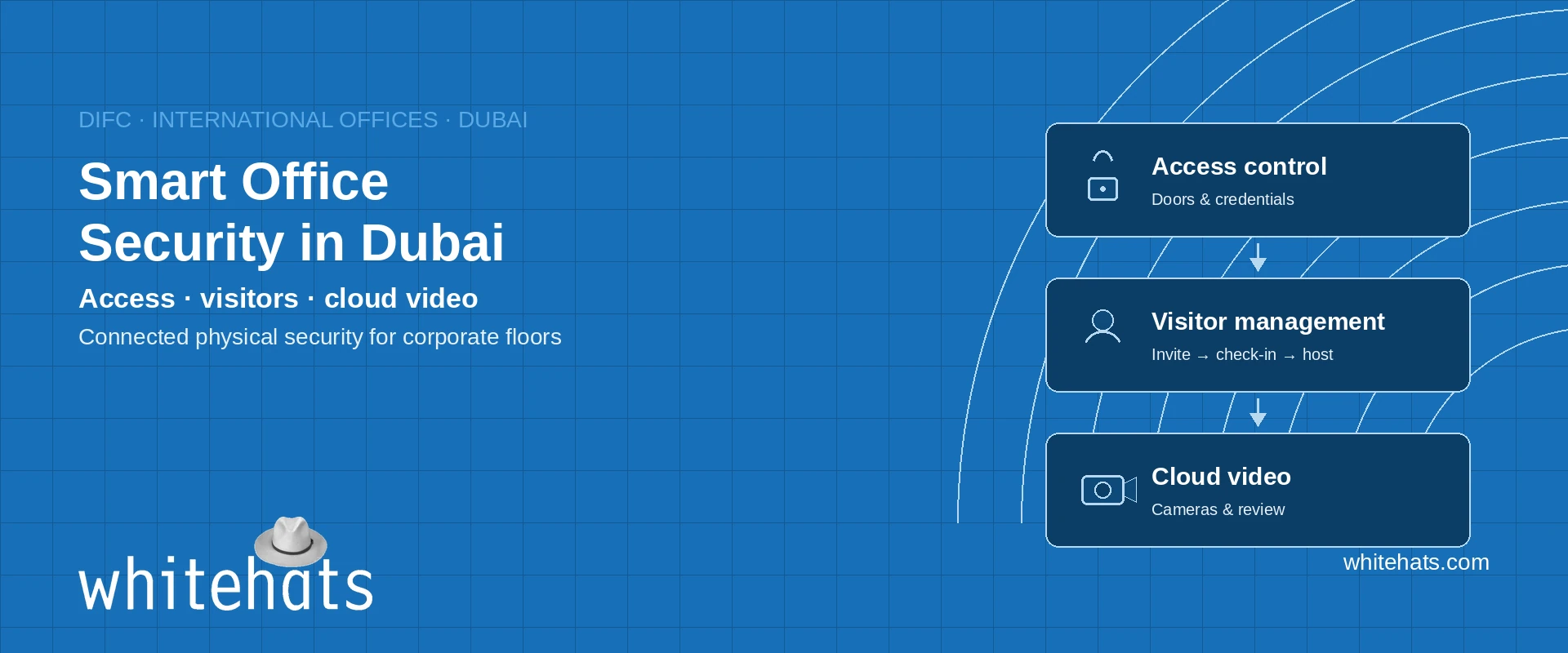
A practical guide to cloud-based access control, intelligent CCTV, visitor management and integrated physical security for corporate offices in Dubai, DIFC and the UAE.
On this page
- Introduction: is your office security system ready for the modern workplace?
- What is Brivo? A modern cloud-based physical security platform
- Brivo access control: smarter door security for corporate offices
- Brivo Visitor Management: transforming reception into a digital experience
- Eagle Eye Networks: intelligent cloud video surveillance beyond traditional CCTV
- Brivo and Eagle Eye integration: one connected physical security environment
- Designing a complete corporate security solution for DIFC offices
- Cloud CCTV vs traditional DVR/NVR for corporate offices
- Physical security for financial institutions, fintech and investment firms in DIFC
- DIFC data protection and CCTV: what businesses should consider
- Can international headquarters manage Dubai office security remotely?
- What a Brivo and Eagle Eye implementation includes
- Which businesses should consider Brivo and Eagle Eye solutions?
- Why choose Whitehats for Brivo and Eagle Eye solutions in Dubai?
- Frequently asked questions about Brivo, Eagle Eye and visitor management
Introduction: is your office security system ready for the modern workplace?
For international businesses establishing or operating offices in Dubai, physical security is no longer limited to CCTV at entrances and access cards for employees. Corporate offices need intelligent, connected and centrally managed security environments that protect employees, visitors, confidential information, infrastructure and physical assets.
Consider a financial services company headquartered in London, with regional offices in Dubai, Frankfurt, New York and Singapore. Its global security team needs visibility into who enters its offices, which employees can reach restricted areas, when visitors arrive, what happens around sensitive locations and how incidents are investigated.
Traditional office security systems often operate independently: access control in a standalone application, CCTV on a local DVR or NVR, visitor registers in spreadsheets or paper, manually updated permissions, and limited overseas visibility. That fragmented model creates administrative work and makes consistent security procedures across international locations harder to maintain.
The direction of corporate physical security is connected, cloud-managed and intelligent. Brivo and Eagle Eye Networks give organisations a practical path to modernise. Whitehats designs and implements modern physical security environments for Dubai offices, incorporating:
- Brivo cloud-based access control
- Brivo Visitor Management, powered by Envoy
- Eagle Eye Networks cloud video surveillance
- AI-powered video analytics and intelligent surveillance (subject to platform edition, camera compatibility and licensing)
- IP CCTV cameras and enterprise recording infrastructure
- Mobile access credentials
- Multi-location security management
- Integrated access control and video surveillance
- Centralised security administration
This guide explains how DIFC and international businesses transform office security with Brivo and Eagle Eye solutions.
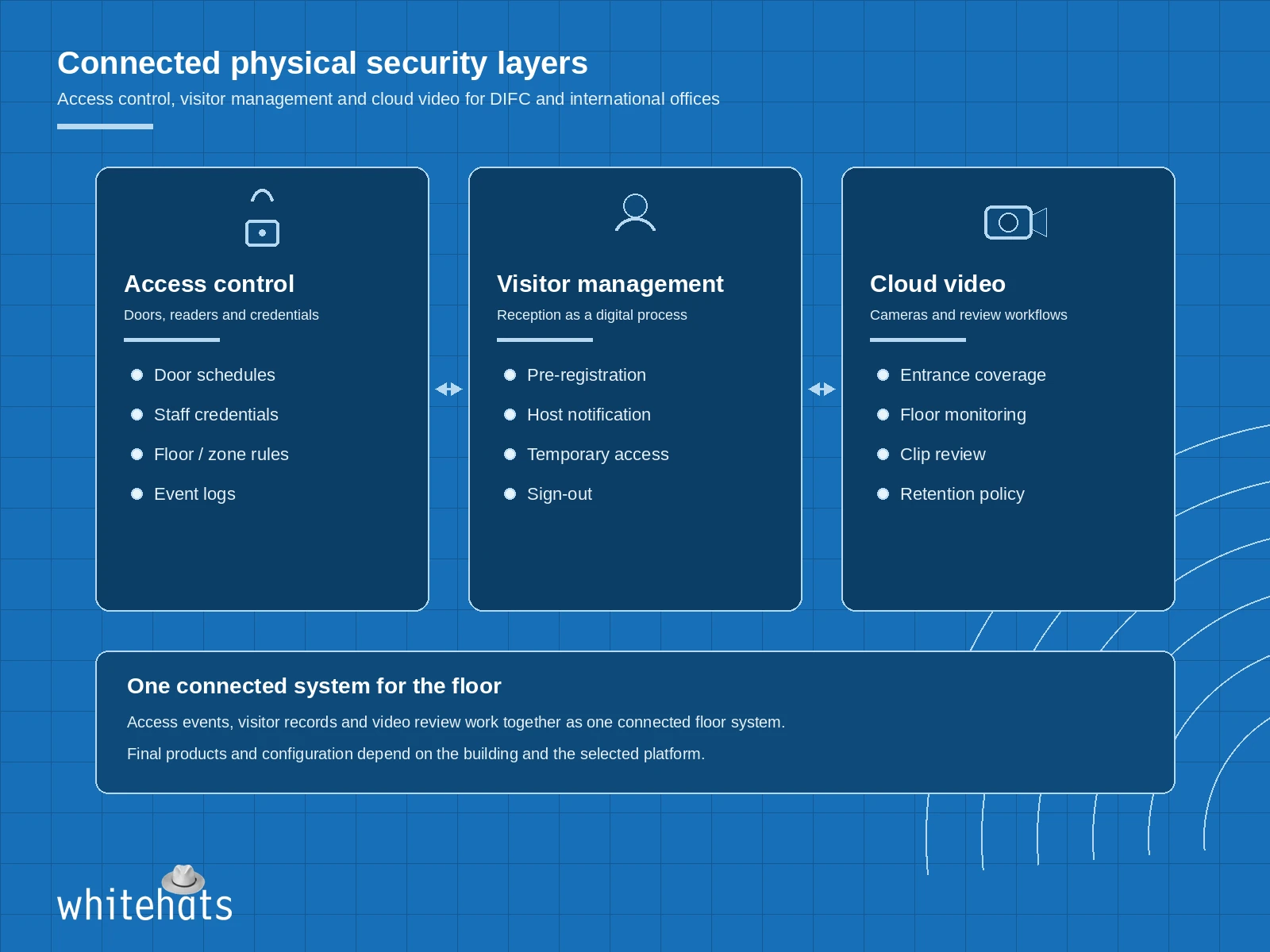
Connected physical security for DIFC and international corporate offices.
1. What is Brivo? A modern cloud-based physical security platform
Brivo is a cloud-native physical security platform designed to help organisations manage access control, video intelligence, visitor management and other connected security operations. Instead of depending entirely on traditional standalone access-control servers and locally managed applications, organisations administer supported security operations through a centralised cloud platform. For businesses with multiple offices, that creates an opportunity to standardise security administration across locations.
What Brivo can do for your business
- Cloud-based access control — manage authorised access to office entrances, restricted departments, server rooms, executive areas and other controlled spaces
- Mobile access credentials — authorised employees use supported smartphones and mobile credentials instead of relying only on traditional cards
- Centralised administration — manage users, credentials, access permissions, schedules and events across supported locations
- Visitor management — register visitors, arrange pre-approvals, notify hosts and manage temporary access through Brivo Visitor Management, powered by Envoy
- Video integration — connect access events with relevant camera footage during investigations
- Security monitoring — review events, alerts and activity records in a centralised environment
- Multi-site management — support consistent access-control policies across offices in different cities and countries
For an international company with a Dubai office of any size, the ability to manage physical security remotely simplifies administration. See Whitehats’ Brivo access-control page.
2. Brivo access control: smarter door security for corporate offices
Access control is a core element of modern corporate security. Traditional systems commonly rely on proximity cards, standalone controllers and locally managed software. Those systems can provide basic restrictions, but they become harder to manage as organisations grow, employees move between locations and security requirements change. Brivo introduces a cloud-managed approach.
How Brivo access control works
A typical Brivo deployment consists of access-control management software, door controllers and supporting hardware, RFID/NFC/Bluetooth or other supported readers, electronic door locks, user credentials and access permissions, plus network connectivity and power infrastructure. When an employee presents an authorised credential, the system evaluates permissions and grants or denies access. Administrators manage supported users, credentials, schedules and permissions centrally.
Key features and business benefits
- Centralised door management — manage multiple entrances and controlled areas from one administration environment
- Role-based access permissions — finance, IT, senior management, reception and contractors receive access appropriate to their roles and schedules
- Mobile credentials — reduce dependence on physical cards where supported readers, devices and licensing allow
- Remote access administration — revoke or issue credentials without waiting for a physical card to be collected
- Access event reporting — credential activity, door events and access attempts for authorised security review
- Multiple office locations — consistent access management practices across sites, with appropriate administrative roles
Where Brivo access control fits
Brivo can be considered for DIFC corporate offices, financial institutions and investment firms, banks and financial services offices, fintech companies, law firms and consulting organisations, private offices and executive suites, server rooms and data-sensitive areas, commercial office buildings, multi-floor corporate premises and multi-location enterprises. Exact design depends on doors, locking mechanisms, credential requirements, security policies and integration architecture.
3. Brivo Visitor Management: transforming reception into a digital experience
Corporate reception is often the first point of contact for clients, partners, suppliers, auditors and visitors. Many offices still depend on manual visitor registers, receptionist-managed spreadsheets or disconnected applications. That creates waiting at reception, delayed host notification, hard-to-retrieve records, manual temporary cards, limited visitor visibility and weak emergency visitor lists.
For international companies, visitor management belongs in the overall physical security strategy.
Brivo Visitor Management, powered by Envoy
Brivo Visitor Management, powered by Envoy, brings a digital visitor experience into the Brivo Security Suite. It manages the visitor journey from pre-registration and check-in through credential issuance and sign-out.
How the visitor management process works
- Visitor pre-registration — a host invites the visitor before the meeting, with arrival instructions
- Digital check-in — visitors use a supported reception kiosk; workflows can collect details, screening questions and policy acknowledgements
- Host notification — the host receives an automatic arrival notification
- Visitor identification — printed badges and digital identification options according to configuration
- Temporary access permissions — where configured and supported, temporary PINs, QR-based credentials or mobile credentials with defined validity
- Visitor sign-out — departure is recorded and configured access permissions can be revoked automatically
Key visitor management features
- Digital visitor registration
- Pre-registration and invitations
- Reception kiosk self-service check-in
- Automatic host notifications
- Visitor badges
- Temporary access credentials
- Watchlist screening against configured internal lists and procedures
- Digital NDAs and policy acknowledgements
- Visitor reporting for authorised administrators
- Emergency evacuation support using configured visitor records and mustering information
Why visitor management matters for DIFC companies
DIFC businesses regularly receive international clients, institutional investors, auditors and consultants, legal representatives, business partners, external IT providers, maintenance contractors, recruitment candidates, and regulators and other authorised visitors. For financial institutions, law firms, investment companies and professional services organisations, controlled visitor registration is an operational requirement. A digital visitor platform improves the visitor experience while giving reception, facilities and security teams better visibility — without compromising security.
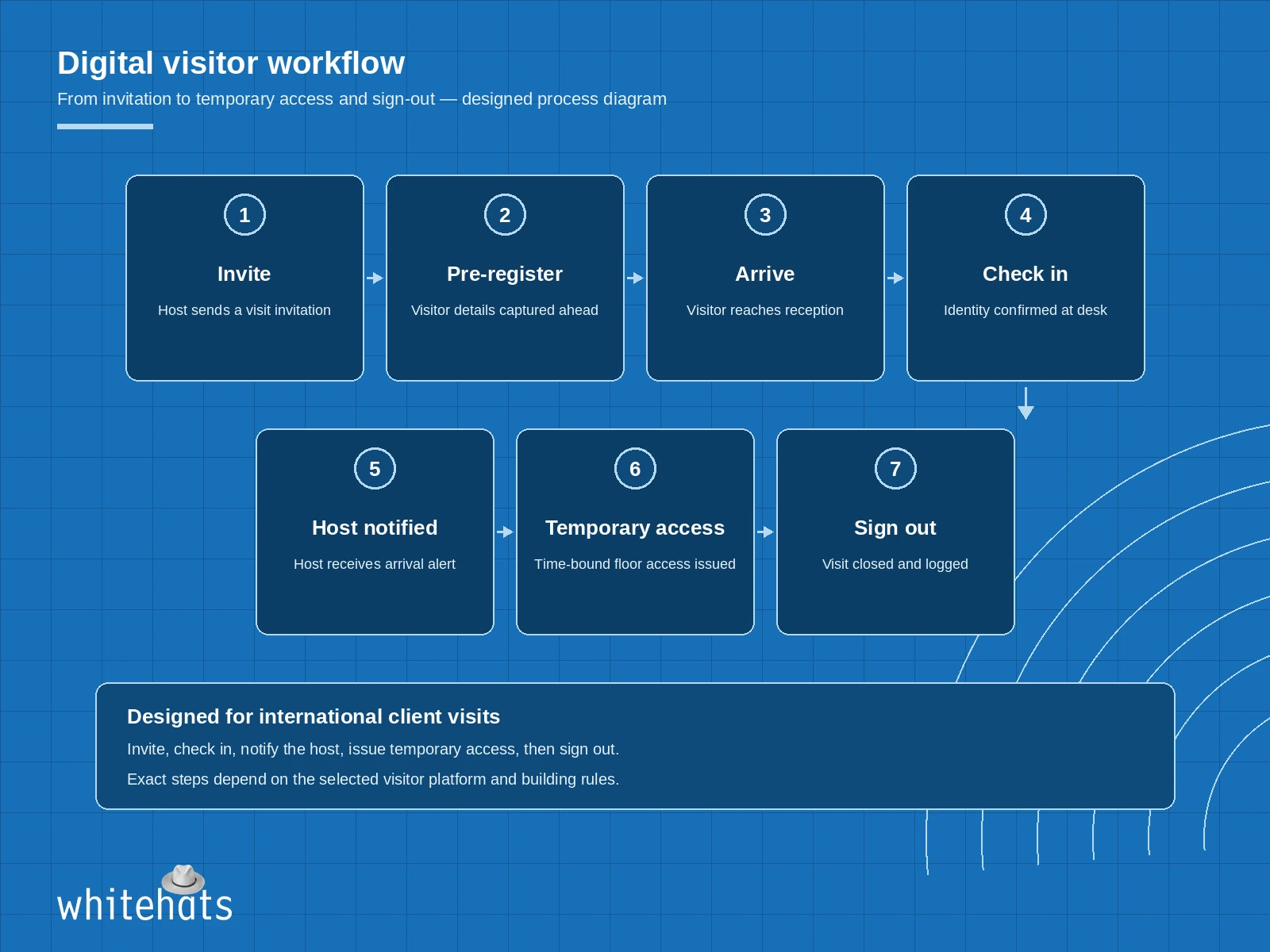
Digital visitor workflow from invitation to temporary access and sign-out.
4. Eagle Eye Networks: intelligent cloud video surveillance beyond traditional CCTV
CCTV systems have traditionally recorded events and provided footage after something goes wrong. Modern video surveillance can do more. Eagle Eye Networks provides a cloud video management platform that turns compatible cameras into a centrally managed video security environment, with cloud-connected management, remote access, AI analytics and supported integrations.
How Eagle Eye differs from traditional CCTV
A traditional deployment may involve IP cameras, network video recorders, local storage, monitoring screens, standalone viewing software and manual footage retrieval. Eagle Eye introduces a cloud video management architecture that can combine local recording, cloud storage or hybrid storage according to the selected configuration — giving organisations more flexibility in how they deploy, manage and access surveillance.
Key Eagle Eye Networks capabilities
- Cloud-based video management
- Remote video access through supported web and mobile interfaces
- AI-powered video analytics (subject to edition, camera compatibility and licensing)
- Smart video search to locate relevant recordings more efficiently
- Multi-location surveillance from a centralised account
- Flexible storage — supported cloud, on-premises or hybrid configurations
- Open integrations with supported third-party technologies
- Security and system health monitoring for cameras and recording infrastructure
AI video analytics and smart video search
Eagle Eye supports various analytics depending on platform edition, camera compatibility and licensing. Examples include line-crossing detection, intrusion detection, object counting, loitering detection, person and vehicle detection, license plate recognition, smart video search and camera tampering detection. These capabilities help security teams identify relevant events and investigate incidents more efficiently.
5. Brivo and Eagle Eye integration: one connected physical security environment
Access control and CCTV are often installed as separate systems. One platform records who entered a door; another records what happened in front of the camera. When these technologies are connected, security teams gain better incident context.
Access-control and video requirements should be reviewed together during project design. Assess the requirements for each system without assuming interoperability.
Practical business scenarios
- Unauthorised access attempt — review the access event and associated video
- Server-room security — credential activity plus visual context
- After-hours access — investigate door events outside normal hours with corresponding video
- Lost access card — revoke the credential and review relevant previous events where necessary
- Visitor access — temporary credentials plus relevant video for designated areas
Benefits for international IT and security teams can include improved investigation, faster access to relevant video, better visibility into physical access activity, centralised administration, more structured reporting and reduced operational complexity — subject to deployment design and permissions.
6. Designing a complete corporate security solution for DIFC offices
Do not design cameras and door readers in isolation. Assess the entire office environment. Whitehats approaches physical security through four interconnected components.
Component 1: Intelligent access control
Use Brivo to manage authorised access to main entrances, employee entrances, meeting rooms, server rooms, finance and confidential departments, executive offices and restricted storage areas.
Component 2: Smart video surveillance
Deploy Eagle Eye Networks with appropriate IP cameras to monitor main entrances, reception, corridors, server rooms where appropriate, restricted departments, meeting-room access points where appropriate, emergency exits and parking or vehicle entrances where applicable. Camera selection should consider field of view, resolution, lighting, mounting height, recording requirements and privacy restrictions.
Component 3: Digital visitor management
Implement Brivo Visitor Management, powered by Envoy, for pre-registration, reception check-in, host notifications, visitor identification, temporary credentials, sign-out, and visitor records and reporting.
Component 4: Centralised administration and monitoring
Connect supported systems and establish responsibilities for user administration, access permission management, camera monitoring, incident investigation, visitor records, reporting and audit trails, and system health monitoring. The objective is a connected, manageable physical security environment — not multiple independent installations.
7. Cloud CCTV vs traditional DVR/NVR for corporate offices
IT directors and facility managers often ask whether to keep traditional CCTV recording or move to cloud-managed video. There is no universal answer. Architecture depends on bandwidth, storage, privacy, resilience, operations and budget.
| Requirement | Traditional CCTV | Eagle Eye Cloud VMS |
|---|---|---|
| Video management | Primarily local | Cloud-managed |
| Remote access | Depends on configuration | Supported remote access |
| Multi-site management | Often separate systems | Centralised management |
| Storage | Local recorder | Cloud, local or hybrid |
| AI analytics | Depends on recorder/camera | Supported AI analytics |
| Video investigation | Often manual | Smart search capabilities |
| Scalability | May require recorder expansion | Designed for scalable deployment |
| Integrations | Varies by system | Open platform and supported integrations |
| Remote administration | Often limited | Centralised administration |
For international businesses, cloud video management can simplify access to surveillance footage across locations — for example a regional security manager in Dubai and an authorised global administrator in London. Cloud-managed architecture can support that model, subject to permissions and connectivity.
Cloud CCTV does not mean all video must be stored in the cloud. Eagle Eye offers flexible storage architectures, including supported local, cloud and hybrid approaches. Design the architecture after a technical assessment.
8. Physical security for financial institutions, fintech and investment firms in DIFC
DIFC hosts international financial institutions, investment firms, wealth management companies, fintech organisations and professional services providers with demanding security requirements. These organisations may handle confidential financial information, sensitive client records, intellectual property and other business-critical assets. Physical security should balance employee convenience with controlled access.
Recommended security architecture themes
- Main entrance — access-controlled entry, reception visitor management, CCTV monitoring, host notification workflow
- Employee areas — role-based permissions, mobile credentials or access cards, camera coverage in appropriate common areas
- Server and network rooms — restricted permissions, access-event monitoring, appropriate camera coverage, defined administrative access policies
- Executive and confidential departments — additional restrictions, defined visitor approval procedures, relevant surveillance coverage
- Meeting rooms — appropriate access and visitor procedures where required; privacy-conscious camera placement
- Parking and external entrances — suitable surveillance; vehicle access management and supported license plate recognition where applicable
Final design must align with the organisation’s risk assessment, office layout, security policies and applicable regulations.
9. DIFC data protection and CCTV: what businesses should consider
Deploying CCTV, access control and visitor management involves processing information that may identify individuals — employee access logs, visitor names and contact information, visitor photographs where collected, CCTV recordings, vehicle registration information, security incident records and visitor screening information.
For organisations operating in DIFC, the DIFC Data Protection Law and applicable regulations should be considered. Assess purpose of collection, access restrictions, data retention, data security, transparency, and any cross-border access or transfer requirements.
Does installing Brivo or Eagle Eye automatically make an office DIFC compliant?
No. Technology can support security and data-governance objectives, but product installation alone does not establish regulatory compliance. The organisation must assess processing activity, policies, retention, access permissions, vendor arrangements and applicable legal obligations. Whitehats handles technical implementation and security configuration. Legal and regulatory interpretation belongs with the organisation’s privacy or legal advisers.
10. Can international headquarters manage Dubai office security remotely?
Yes — when deployment, administration model and permissions are properly designed. This is particularly valuable when global IT and security departments operate outside the UAE. Brivo and Eagle Eye can support centralised management of connected security environments for employee access permissions, visitor activity, restricted-area access, security events, CCTV footage, credentials and incident investigation.
Benefits for global security teams include centralised visibility, consistent policies, faster remote investigation with local coordination, reduced administrative dependency for routine credential work, and structured reporting for authorised review.
Integration with corporate identity systems
11. What a Brivo and Eagle Eye implementation includes
A successful project involves more than purchasing readers and cameras. Whitehats treats these deployments as complete technology implementation projects.
- Site assessment — floor plans, doors, locking hardware, existing access control, CCTV coverage, reception workflows, network, storage/retention, IT and security policies
- Solution design — Brivo design, controllers and readers, locking mechanisms, Eagle Eye camera architecture, storage model, visitor workflows, network/power, integrations
- Hardware and infrastructure installation — panels, readers, locks, cameras, Eagle Eye bridges or supported recording infrastructure, switches, cabling, power and UPS
- Platform configuration — doors, access groups, permissions, schedules, mobile credentials, visitor workflows, cameras, retention, notifications, admin roles
- Integration and testing — employee access, visitor journeys, temporary credentials, door events with associated video, recording, remote video access, permissions, reporting
- Training and handover — administrator and user training, documentation, configuration information, asset records and operational procedures
- Ongoing support — local assistance for maintenance, troubleshooting, administration and expansion according to agreed service scope
12. Which businesses should consider Brivo and Eagle Eye solutions?
| Industry | Potential application |
|---|---|
| Financial services | Restricted access, CCTV and visitor tracking |
| Investment firms | Confidential office security |
| Banks | Controlled areas and surveillance |
| Fintech | Smart office access and video security |
| Law firms | Confidential departments and visitor management |
| Consulting companies | Employee and visitor access |
| Corporate headquarters | Multi-location security administration |
| Commercial real estate | Tenant access and building security |
| Technology companies | Server rooms and restricted infrastructure |
| Family offices | Controlled access and security monitoring |
DIFC businesses frequently operate inside international groups. Security requirements may be defined by global headquarters while deployment happens locally. Whitehats works with global IT departments, regional security teams, corporate procurement, facility management, office operations and building-management stakeholders to translate global requirements into a designed and supported local implementation.
13. Why choose Whitehats for Brivo and Eagle Eye solutions in Dubai?
Choosing a physical security provider should involve more than comparing camera, reader and controller prices. The implementation partner should understand networking, cybersecurity, physical security, cloud infrastructure and ongoing support.
Whitehats is a Dubai-based IT infrastructure, cybersecurity and managed services provider. The approach brings IT infrastructure and physical security implementation together:
- Local implementation experience in commercial offices and international business environments in Dubai
- Brivo access-control design and implementation, including user management, mobile credentials and supported integrations
- Eagle Eye video surveillance architecture, compatible cameras, cloud video management and supported analytics
- Digital visitor management to replace manual visitor registration
- Integrated security architecture across access control, video and visitor workflows
- Enterprise IT expertise — network segmentation and security controls for security devices and platforms
- International headquarters coordination to align local implementation with corporate standards
- Ongoing local support through agreed support and maintenance arrangements
Related reading on Whitehats.com: unified cloud security with Brivo and Eagle Eye Networks and SIRA-approved CCTV in Dubai.
14. Frequently asked questions about Brivo, Eagle Eye and visitor management
Speak with Whitehats
Whether you operate a financial institution in DIFC, a fintech company in Dubai, an international corporate office or a multi-location enterprise, Whitehats plans and implements Brivo access control, Eagle Eye intelligent video surveillance and Brivo Visitor Management powered by Envoy. Request a Brivo and Eagle Eye security assessment aligned with your IT architecture and security policies.
UAE companies with 20+ staff can request a free onsite IT Support & Security Assessment.
Contact: contact Whitehats | +971 4 338 2500
Whitehats LLC — Al Quoz 3, Dubai, UAE